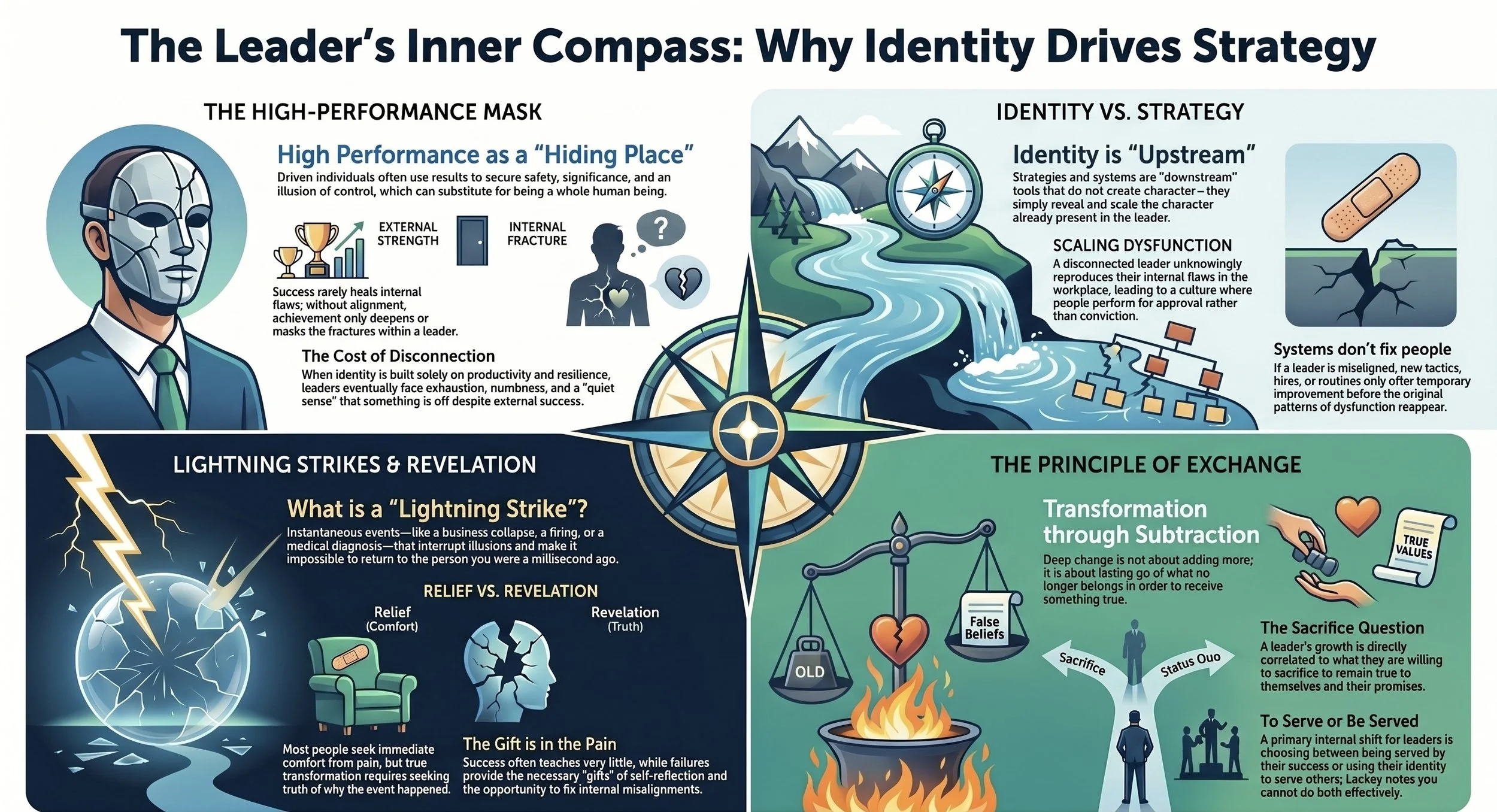


We are trapped in the "game of enough," a psychological treadmill where we believe that more revenue or more accolades will finally buy us peace. But here is the cold truth: there is no "top" to the mountain of enough. This hustle is an automatic survival mechanism, not a strategy. On your deathbed, you aren't going to wish you closed that merger; you’re going to wish you hadn't been "time-traveling" through your children's soccer games because you were too busy worrying about a client you might lose. To find true agency, you must move from automatic reaction to conscious presence.
Organizational Discipline|Scaling CEOs, Decision Bottlenecks, and the Success by Design Framework| S5E44 Continuous Improvement Lab
You have built a successful business, likely crossing the $1 million revenue mark through sheer force of will, talent, and late nights. But lately, the momentum has shifted. You feel like you are running in sand. Your calendar is a graveyard of back-to-back meetings, your team seems hesitant to move without you, and you are reaching the limits of your physical and mental endurance.
System Thinking|Winning the Generational War with Gentelligence|S7E58 System Thinker Show
If you think generational friction is just a "soft" HR issue, look at the bottom line: In 2020, PwC agreed to pay $11.6 million to settle an age-discrimination lawsuit regarding its recruitment practices. Similarly, IKEA has faced multiple lawsuits alleging a corporate culture of age bias where older workers were passed over for "new and innovative" younger candidates. When we allow generational shaming to go unchecked, we transform a diversity of thought into a hard legal and financial risk.
System Thinker|Why your enemies make better teammates|S7E57 The Systems Thinker show
In the modern corporate landscape, we are conditioned to believe that organizational health is a byproduct of seamless harmony and warm professional circles. There is an insidious comfort in the "Camaraderie Trap"—the instinct to populate our inner circles with friends and trusted allies who mirror our perspectives. Yet, this reliance on "blind trust" frequently masks a cold reality: a gradual descent into groupthink, creative stagnation, and a catastrophic decline in operational rigor.
Management Operating System|Structure Versus Culture|S4E42 Continuous Improvement Lab
It is the silent killer of operational excellence: the process that was once heralded as a lean solution but has mutated into a bloated administrative anchor. We have all seen it—the weekly huddle that now lasts ninety minutes, or the "streamlined" dashboard that requires three full-time employees just to update. What began as a tool for clarity has become a "check-the-box" exercise where the system demands more energy than the problems it was built to solve.
Systems Thinking|Assume Formlessness Through Disciplined Flexibility| S6E55 - The Systems Thinking Show
In an era defined by volatile demand, labor constraints, and cascading supplier disruptions, the greatest threat to an organization isn’t a lack of discipline—it is rigidity. Standard Operating Procedures were designed as armor; in today’s volatility, they have become a straitjacket. Many organizations operate as "brittle" systems: they are highly optimized and efficient under laboratory conditions, but they shatter the moment reality diverges from the plan.
量化升級門檻的盲點 S4E41
營運數據重質不重量 S4E40
Operational Discipline|Do Strict Escalation Triggers Acceleration|S4E41 Continuous Improvement Lab
In the high-pressure environments of modern industry, "firefighting" is frequently misdiagnosed as productivity. It is a pervasive workplace frustration: a minor mechanical hiccup or a slight quality deviation occurs, but frontline workers—uncertain of the threshold for intervention—attempt to resolve the issue in isolation. By the time the problem surfaces to management, it has snowballed into a catastrophic production stoppage.
Management Operating Systems| Prioritize Data Integrity Over Volume| S4E40 - Continuous Improvement Lab
Most leaders begin their day buried under 50-page slide decks and exhaustive dashboards, yet they often struggle to answer a fundamental question: Why did we miss our target yesterday? This is the "data drowning" reality of the modern enterprise. We operate under the flawed assumption that volume equals insight, but in practice, excessive data often creates "decision latency" and operational friction. The counter-intuitive truth known to the most effective organizations is that a leaner data set—rooted in integrity and actionability—is the ultimate catalyst for high-velocity decision-making. To reclaim productivity, leadership must pivot from managing the quantity of metrics to ruthlessly protecting the integrity of the information.