
Beyond the "OK Boomer" Wars: 5 Surprising Keys to Unlocking Intergenerational Power
In 2007, a 60 Minutes segment hosted by Morley Safer introduced Millennials to the world not as new colleagues, but as a "plague" that the business world would have to survive. Safer famously framed the modern office as a "psychological battlefield," effectively throwing down a gauntlet that has fueled over a decade of generational shaming. Today, that "us-versus-them" mentality is doing more than just hurting feelings—it is a significant "loss of talent potential" that carries a heavy price tag.
If you think generational friction is just a "soft" HR issue, look at the bottom line: In 2020, PwC agreed to pay $11.6 million to settle an age-discrimination lawsuit regarding its recruitment practices. Similarly, IKEA has faced multiple lawsuits alleging a corporate culture of age bias where older workers were passed over for "new and innovative" younger candidates. When we allow generational shaming to go unchecked, we transform a diversity of thought into a hard legal and financial risk.
To end these wars, leaders must move beyond scapegoating and embrace Gentelligence. This revolutionary approach, coined by Megan Gerhardt, PhD, views generational differences not as a threat to be managed, but as an asset to be leveraged. As George Orwell famously observed: "Each generation imagines itself to be more intelligent than the one that went before it, and wiser than the one that comes after it." Gentelligence is the tool that allows us to look past this biological ego and see the actual power sitting across the desk.
--------------------------------------------------------------------------------
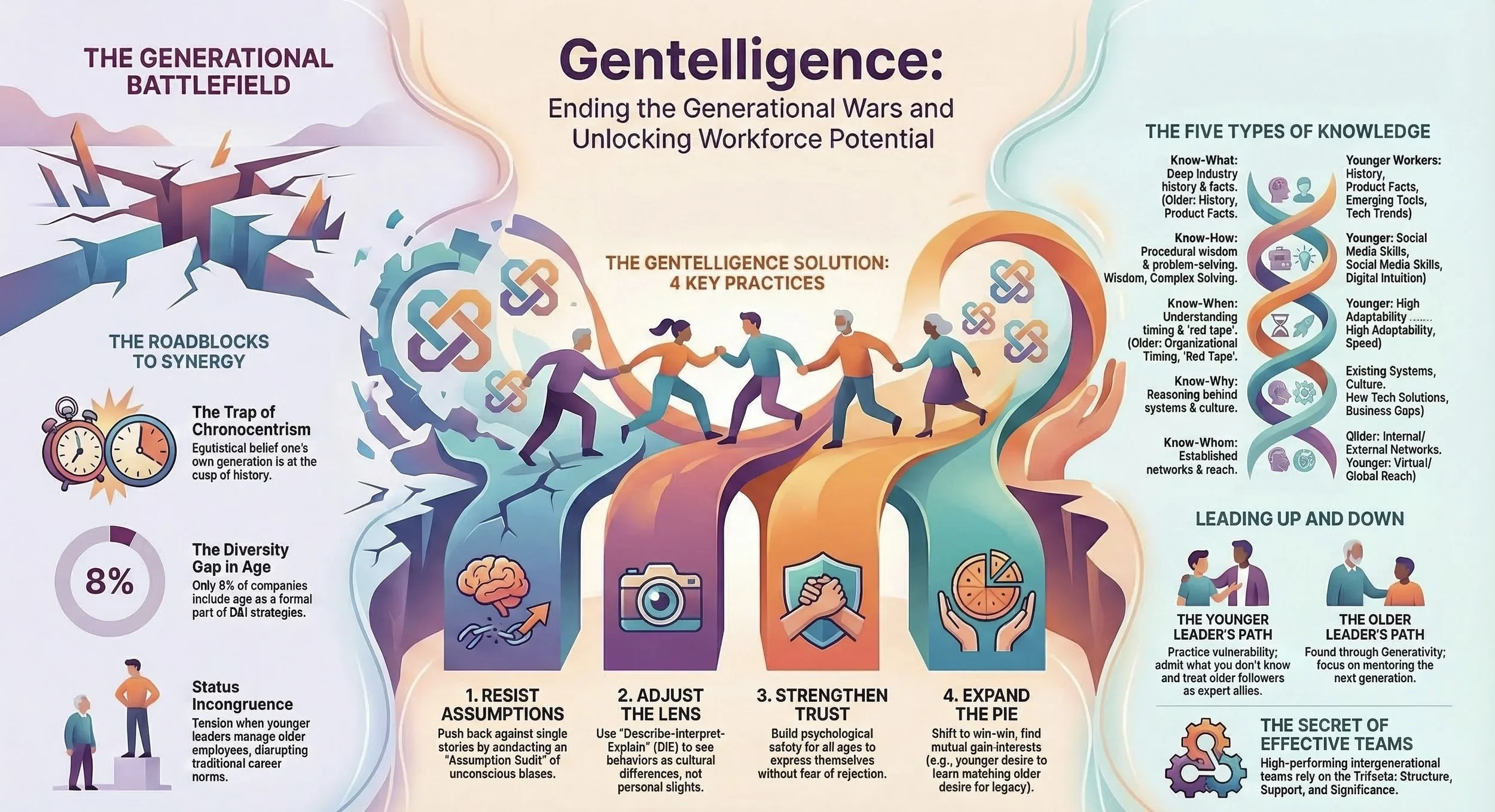
1. Beware of "Chronocentrism" (The Ego of Our Own Era)
The primary psychological roadblock to effective collaboration is a concept identified by sociologist Jib Fowles: Chronocentrism.
"Chronocentrism is the egotistical belief that one’s own times are paramount and others pale in comparison."
This mindset is the direct antithesis of Gentelligence. It acts as a "single story" that blinds us to others' value, leading us to dismiss older methods as obsolete or younger methods as "lazy." To dismantle this "single story," we must utilize the DIE Approach (Describe, Interpret, Explain).
Instead of jumping to a judgmental conclusion when a Gen Z employee pulls out a laptop in a meeting (Interpretation: "They are being rude"), start by Describing the behavior objectively ("They are typing during the presentation"). Then, seek an alternative Explanation ("Maybe they are taking notes or live-tweeting insights to our clients"). By forcing this pause, we move from being judgmental to being curious, shifting the focus from the era we belong to toward the goals we share.
--------------------------------------------------------------------------------
2. We Share the Same Values, We Just Speak Different "Dialects"
A common myth is that Boomers and Zoomers have fundamentally different values. In reality, four universal values remain constant across the workplace:
Respect: The desire to feel valued and vital.
Competence: The need to be perceived as knowledgeable and skilled.
Connection: The drive for collaboration and mutual trust.
Autonomy: The desire for independence and judgment.
The friction arises because we speak different "dialects" of these values. Consider the "Indiana Boss" who was deeply offended when young hires called him by his first name, "Bob." To him, Respect was signaled by titles (Mr. Jones) and hierarchy. To the Millennials, calling him "Bob" was a signal of Connection and informality they were raised to value. Both sides wanted a positive relationship, but they suffered from a "translation error." Moving the conversation from "they have bad values" to "we have a dialect disconnect" allows for authentic bridge-building.
--------------------------------------------------------------------------------
3. The Five Dimensions of Knowledge (It’s Not Just About Tech)
In 2007, Mark Zuckerberg claimed "young people are just smarter." This reflects a "Know-How" bias that prioritizes digital fluency over all other intelligence. However, Gentelligence identifies five dimensions of knowledge that must work in tandem:
Know-what: Facts and information. While younger workers may know the latest digital trends, older workers possess deep, job-specific knowledge of industry history and customer behavior.
Know-how: Procedural skills. A "Younger Genius" might have natural tech skills, but an "Old Master" brings high-level social competencies. Consider the lab of Dr. Joshua Pearce: when a part broke, the younger researchers knew exactly how to find it on Amazon, but the older master used his knowledge of mechanics to build a superior version from scratch using spare parts in the lab. Both forms of "Know-how" were vital.
Know-when: Timing and context. Older workers understand organizational "red tape" and when to navigate it; younger workers bring an awareness of when the market is shifting and it’s time to pivot.
Know-why: Reasoning and history. Younger workers excel at matching new solutions to business challenges, but older workers understand why a system was built a certain way in the first place, preventing the team from repeating past mistakes.
Know-whom: Relational intelligence. Older workers have spent decades building internal and external political networks; younger workers possess extensive virtual social networks with global reach.
--------------------------------------------------------------------------------
4. The Power of "Leapfrogging" and Vulnerable Leadership
We are currently navigating a "New Organizational Order" where 40% of workers report to a younger boss. This can trigger Status Incongruence—the psychological discomfort that occurs when career norms (older = higher rank) are violated.
For younger leaders, the "Gentelligent Opportunity" lies in using vulnerability as a strength. Instead of overcompensating by pretending to have all the answers, the most effective young leaders embrace their role as "change champions" while asking the Modern Elder (a term popularized by Chip Conley) one powerful question: "How would you do it?"
For older leaders, the psychological milestone to strive for is Generativity. As identified by psychologists like Dan McAdams, this is the developmental stage where an individual finds meaning not by protecting their "clout," but by guiding and developing the next generation. By shifting from self-preservation to mentorship, the veteran leader ensures their wisdom becomes a legacy rather than a lost relic.
--------------------------------------------------------------------------------
5. Stop Fighting Over the Pie—Expand It
Generational conflict is fueled by the "Mythical Fixed Pie" mindset—the belief that if a younger person gains influence, an older person must lose relevance. To overcome this, we must build "Intergenerational Social Capital" by Expanding the Pie.
A practical way to do this is the "Ask Me About" exercise. Employees of all ages identify a unique area of expertise they are willing to share. In one session, a Gen Z employee might list: "Ask me about doubling Twitter followers in a week," while a Boomer veteran lists: "Ask me about closing the toughest sale in the Midwest."
When the veteran asks the junior for social media tips, and the junior asks the veteran for negotiation strategies, the "pie" of organizational knowledge expands for everyone. This reciprocity turns generational adversaries into strategic allies, creating a competitive advantage that "chronocentric" companies simply cannot match.
--------------------------------------------------------------------------------
Conclusion: A Forward-Looking Summary
The movement toward Gentelligence has two broad goals: breaking down the barriers of bias and assumptions, and building up the capacity for shared trust and power. It is a transition from leading for the past to leading for the future of work.
As you look at your team tomorrow, conduct an "Assumption Audit": Are you leading based on a "single story" or a generational stereotype, or are you actually seeing the talent in front of you? Are you leading for a world that used to exist, or for the one we are building together?
As Henry David Thoreau once wrote: "The question is not what you look at, but what you see."