
Why Your Best Hires Might Be Your Worst Enemies (and Vice-Versa)
The "Camaraderie Trap" Introduction
In the modern corporate landscape, we are conditioned to believe that organizational health is a byproduct of seamless harmony and warm professional circles. There is an insidious comfort in the "Camaraderie Trap"—the instinct to populate our inner circles with friends and trusted allies who mirror our perspectives. Yet, this reliance on "blind trust" frequently masks a cold reality: a gradual descent into groupthink, creative stagnation, and a catastrophic decline in operational rigor.
Robert Greene, the behavioral historian whose work was famously galvanized by Julius Caesar’s decision to cross the Rubicon, posits a counter-intuitive truth. While the warmth of a friend’s support feels indispensable, it is often a strategic liability that blinds a leader to emerging threats. In the pursuit of sustainable power and innovation, the very people we consider our safest hires may be the ones most likely to compromise our interests.
The Paradox of Envy: Why Friends Are a Liability
The fundamental danger of relying on friends in a professional capacity is the inevitable erosion of objectivity. Familiarity breeds a sense of entitlement; friends often discern themselves as deserving of special exemptions from the high standards applied to others. This dynamic frequently shifts toward "spoiled and tyrannical" behavior, where the professional boundary dissolves into personal expectation and a refusal to acknowledge the leader’s authority.
Furthermore, honesty rarely strengthens a friendship in the manner we idealistic professionals imagine. As noted in Greene’s psychological framework, friends are often more inclined to offer performative praise than the biting, necessary criticism required for survival. They may claim to admire your creative output while secretly harboring a corrosive resentment born of proximity. Because envy is easily aroused among equals, your professional success can inadvertently trigger a destructive competitive reflex in those you trust most.
"Be wary of friends—they will betray you more quickly, for they are easily aroused to envy. They also become spoiled and tyrannical."
The superficiality of these professional bonds is often hidden behind a mask of agreement. Friends will say they love your poetry, adore your music, or envy your taste in clothes, but these affirmations are frequently hollow. In a high-stakes environment, this lack of genuine friction creates dangerous blind spots, as the social desire to remain "liked" overrides the professional necessity of being correct.
The Loyalty of the Converted: The Strategic Value of Enemies
Conversely, a vocal critic or former adversary offers a unique form of strategic utility that the "comfortable" friend cannot match. When an enemy is brought into the fold, they possess a potent motivation that is entirely absent in a friend: the desperate need to prove their worth. A former enemy understands that their position is not guaranteed by affection but earned through exceptional performance, leading to a relationship rooted in mutual respect rather than social assumption.
Transforming a detractor into an ally is a sophisticated "strategic maneuver" that replaces the blind spots of friendship with the "clear eyes" of professional necessity. Enemies provide a sharper, more objective perspective precisely because their judgment isn't clouded by a desire to maintain a social equilibrium. By hiring a former enemy, a leader secures a partner who understands the power dynamic and respects the effort required to bridge the initial divide.
"But hire a former enemy and he will be more loyal than a friend, because he has more to prove."
The Innovation Engine: Friction as a Performance Metric
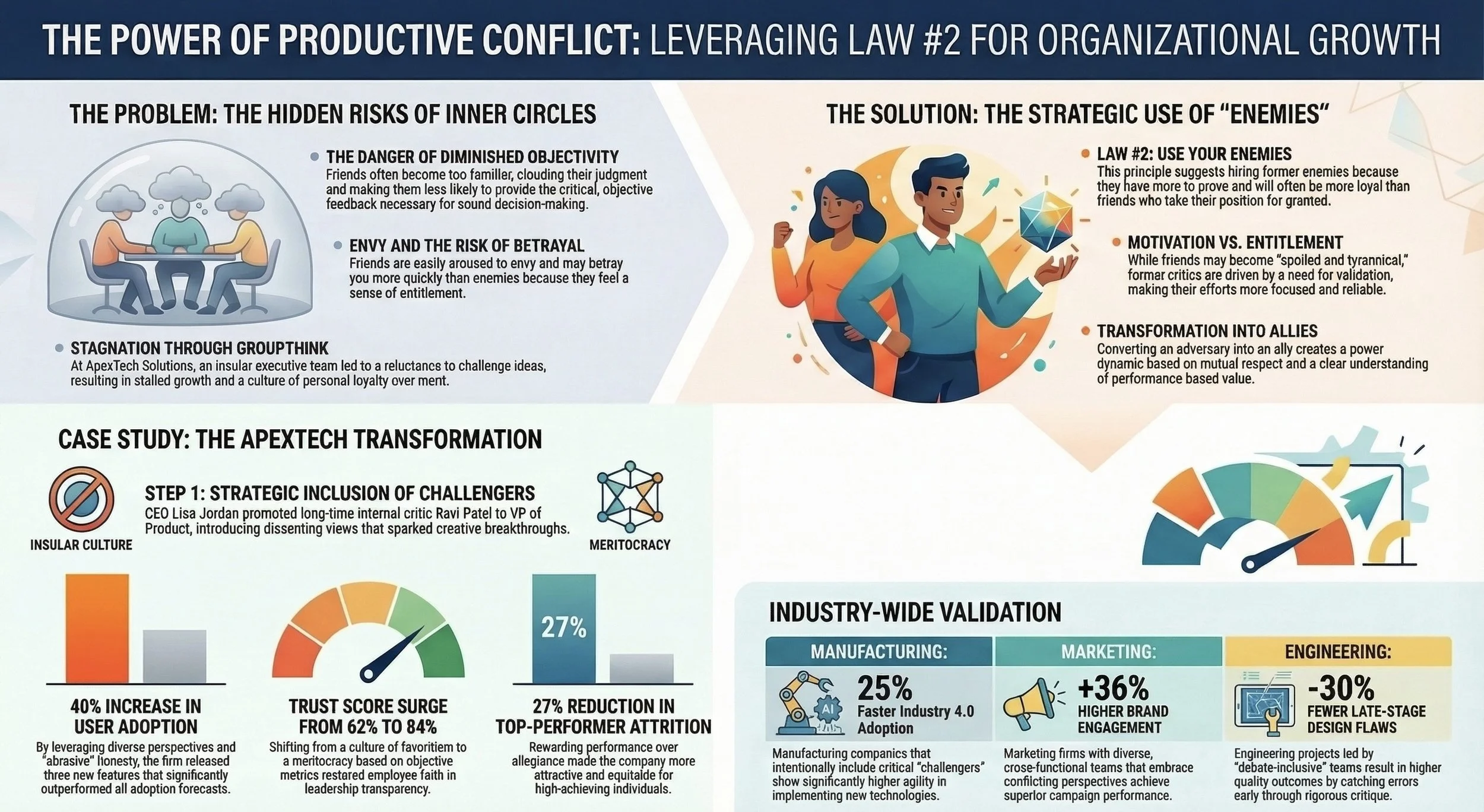
Data across multiple high-stakes industries confirms that intellectual rivalry serves as a vital safeguard against institutional oversight. "Debate-inclusive" teams—those that strategically incorporate challengers and dissenting voices—consistently outperform those built on pure consensus and close affiliations.
Manufacturing: A 2023 Deloitte report found that companies utilizing "challengers" see a 25% faster rate of implementing Industry 4.0 technologies compared to those relying on long-standing internal networks.
Marketing: According to McKinsey (2021), teams with conflicting creative views achieve 36% higher brand engagement metrics than teams driven by loyalty-based consensus.
Engineering: The National Society of Professional Engineers (NSPE) reported that "debate-inclusive" environments result in a 30% reduction in late-stage design flaws.
Scientific Research: Blind trust is a documented risk; a 2022 Nature study revealed that 34% of retractions in peer-reviewed studies are attributed to close affiliations between researchers and reviewers.
Case Study: How ApexTech Turned Tension into a 40% Win
ApexTech Solutions, a software firm in Austin, faced a crisis in 2023 when an insular executive team led to organizational paralysis. CEO Lisa Jordan discerned that the firm’s stagnation was a direct result of projects being assigned based on personal loyalty rather than objective merit. To break this cycle, she executed a high-risk maneuver by promoting her most vocal internal critic, Ravi Patel, to VP of Product.
Patel’s "abrasive" honesty introduced immediate friction, but it also forced a level of scrutiny that the previous "clique" had carefully avoided. By shifting from loyalty-based decisions to a meritocracy that leveraged dissenting opinions, the results were transformative:
Trust Score: Increased from 62% to 84% as the broader workforce recognized a new commitment to fairness.
Innovation: New product features outperformed user adoption forecasts by 40% due to the rigorous vetting of Patel’s team.
Retention: Top performer attrition dropped by 27% as high-achieving individuals found more opportunity in a performance-driven culture.
The "Superiority" Secret: Leading from the Shadows
A master of these dynamics understands that power is often most effective when it is invisible. During the ApexTech intervention, Lisa Jordan exemplified a complementary principle to Law 2: Law 1: Never Outshine the Master. After quietly orchestrating a high-profile client turnaround, she allowed her COO to take the public credit for the success.
By making her subordinates and peers feel superior and secure in their own power, Jordan removed the threat of resentment that often leads to internal betrayal. This "Shadow Leadership" reinforces one's own security; by relinquishing the spotlight, a leader fosters a stable hierarchy where subordinates feel unthreatened and therefore more aligned with the leader's interests. Making others feel powerful is not a sign of weakness, but a calculated strategy to ensure one's own position remains unassailable.
Conclusion: From Comfort to Credibility
The transition from a culture of comfort to a culture of credibility requires a fundamental shift in how we judge our professional alliances. True power is not a product of being liked; it is the result of an acute ability to judge who is best able to further your interests in any given situation. While friends provide a psychological safety net, it is often our critics and former adversaries who provide the friction necessary for a competitive breakthrough.
As you evaluate your own professional inner circle, look past the warmth of camaraderie and toward the utility of dissent. The most dangerous person in your network might not be the one who challenges you, but the one who always agrees with you. Whose silence is currently costing you your competitive edge?