
Why Your Best Management Systems Eventually Fail—And How to Keep Them Alive
1. Introduction: The Trap of the "Set It and Forget It" Mentality
It is the silent killer of operational excellence: the process that was once heralded as a lean solution but has mutated into a bloated administrative anchor. We have all seen it—the weekly huddle that now lasts ninety minutes, or the "streamlined" dashboard that requires three full-time employees just to update. What began as a tool for clarity has become a "check-the-box" exercise where the system demands more energy than the problems it was built to solve.
The root cause is a pervasive executive blind spot: the "set it and forget it" mentality. Leaders often treat their Management Operating System (MOS) as a static monument to past success, a rigid set of rules carved in stone. But in a volatile market, a static system is a dying system. To maintain peak performance, your MOS must be a "living framework"—a dynamic, breathing structure that evolves as fast as your business does.
2. Your Management System is a Living Organism, Not a Statue
A Management Operating System is not a fixed destination; it is the vehicle your organization uses to navigate growth. As a company scales, the complexity of communication does not grow linearly—it grows exponentially. Tools that worked for a twenty-person team become obsolete and counterproductive when applied to a workforce of two hundred.
The data suggests a clear mandate for leadership: the system itself must be subject to the same scrutiny as the products it produces. According to research from the Lean Enterprise Institute, the rewards for this agility are substantial.
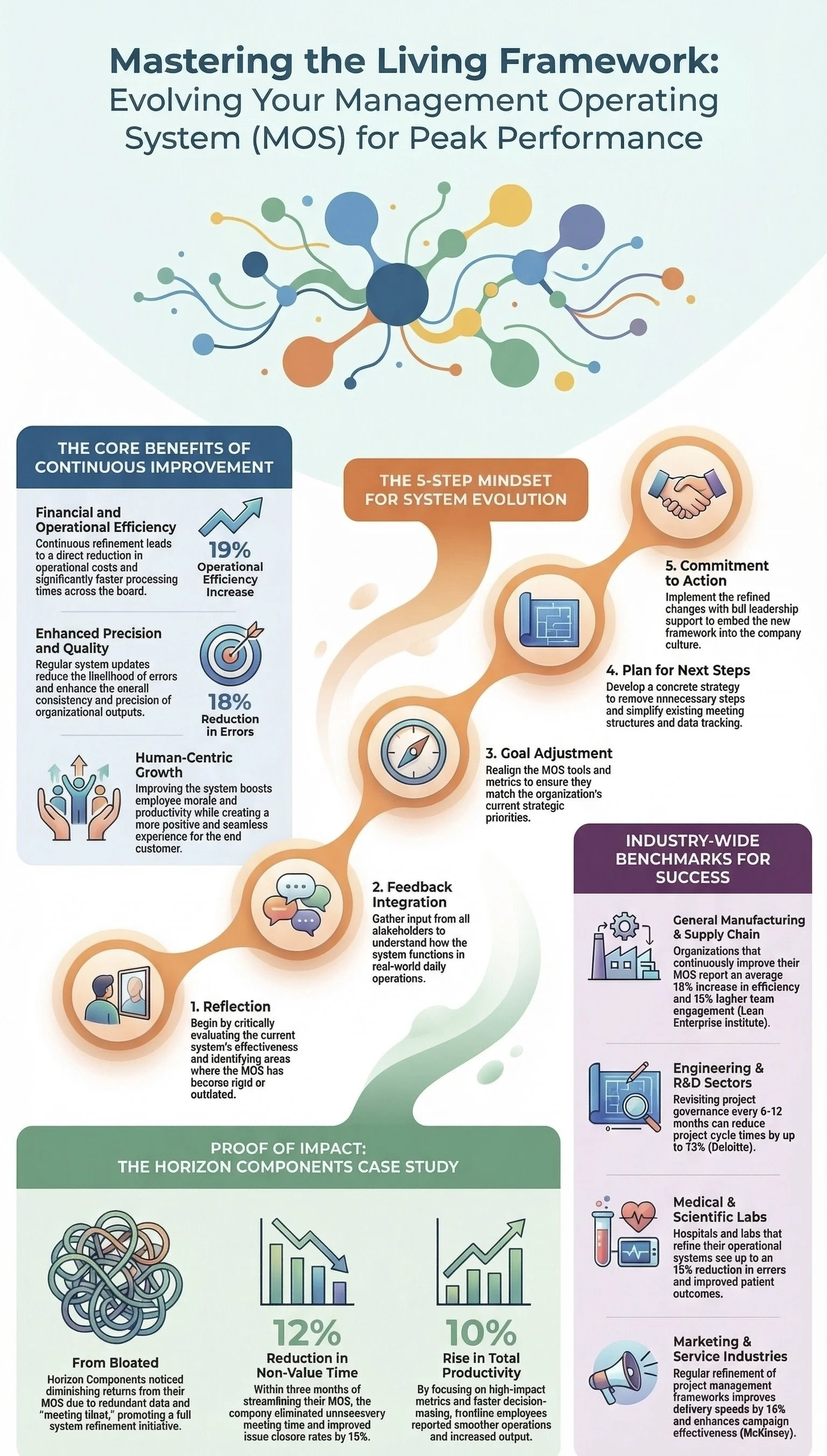
"Organizations that treat the Management Operating System (MOS) as a living framework—regularly reviewing and refining its components—realize a 19% increase in operational efficiency and a 15% boost in team engagement."
When systems remain rigid, they eventually stop serving the business and start serving themselves. By proactively removing non-value-added activities, leaders ensure that their MOS remains a lean engine for growth rather than a weight on the organization’s heels.
3. The "Horizon Warning": Even Successful Systems Can Become Toxic
The danger of an unrefined MOS is best illustrated by the case of Horizon Components, a precision electronics manufacturer. Initially, their MOS was a triumph, stabilizing production and instilling accountability. However, as the business matured, the system began to yield diminishing returns. Meeting agendas became bloated with legacy topics, and teams were buried under redundant data points. The focus shifted from solving shop-floor crises to the bureaucratic maintenance of the tools themselves.
Recognizing the decay, Horizon’s leadership pivoted toward what I call "Strategic Minimalism." They realized that the most effective form of improvement isn't adding more steps—it is the ruthless removal of the unnecessary. By refining their escalation protocols and simplifying their tracking tools to focus only on high-impact metrics, they achieved:
12% reduction in non-value-added meeting time.
15% increase in issue closure rates.
10% overall rise in productivity.
Horizon’s success proves a counter-intuitive truth for the modern executive: often, the best way to improve a system is to cut it back to its essential marrow.
4. The Five-Step Engine of Mindset Growth
To prevent the "administrative bloat" seen at Horizon, organizations must adopt a cyclical engine of refinement. This five-step process prevents stagnation by ensuring the MOS evolves in lockstep with shifting business goals:
Reflection: Periodically auditing current performance to identify where the system has become "heavy."
Feedback Integration: Gathering ground-level insights from those using the system daily.
Goal Adjustment: Using that feedback to realign the system’s objectives with current market realities.
Plan for Next Steps: Designing specific, lean refinements to existing cadences or tools.
Commitment to Action: Rapidly executing changes to keep the system's momentum alive.
The connective tissue here is the transition from Feedback to Goal Adjustment. Without a formal mechanism to turn shop-floor frustrations into high-level system changes, your MOS will remain disconnected from the reality of the work, eventually becoming a relic of the past.
5. Beyond the Factory Floor: Impact Across Every Sector
The necessity of system evolution is a universal principle, spanning from the production floor to the boardroom. Whether in Warehousing, Supply Chain management, or even Education, the ability to revisit and adjust internal operating systems is what separates market leaders from also-rans.
Industry
Key Metric
Performance Impact
Engineering / R&D
Project Cycle Times
13% Reduction (Deloitte)
Medical / Hospitals
Likelihood of Errors
18% Reduction (Industry Research)
Marketing
Project Delivery Speeds
16% Increase (McKinsey)
In the medical sector, refining the MOS reduces errors and improves patient outcomes. In the marketing world, McKinsey finds that teams that regularly prune their meeting cadences and project frameworks see a dramatic spike in campaign effectiveness. The message is clear: if you aren't refining your system, you are losing speed to those who are.
6. The "Kaizen" Culture: Boosting Morale Through Ownership
When we apply the principles of continuous improvement to the system itself, we unlock a powerful psychological byproduct: ownership. At Horizon Components, the MOS was no longer something "done to" the employees; it became the "product" that they were empowered to improve.
Applying Kaizen—continuous improvement—to the MOS creates a culture where frontline staff feel a renewed sense of engagement. When employees see that their feedback can eliminate a redundant meeting or simplify a confusing form, morale skyrockets.
"True operational excellence is achieved only when Kaizen (continuous improvement) principles are applied to the MOS itself, turning the management system into a dynamic tool for employee empowerment."
A refined, agile MOS enhances the consistency and precision of outputs while creating a more positive customer experience. By removing the "clutter" of a legacy system, you free your people to focus on the work that actually generates value.
7. Conclusion: Is Your System Working for You, or Are You Working for Your System?
In my experience, the most successful companies don't just improve their products; they obsessively improve the way they improve. They treat their Management Operating System not as a finished masterpiece, but as a draft that requires constant editing.
The most dangerous phrase in business remains, "This is the way we’ve always done it." As you look at your organization today, I challenge you to perform a ruthless audit:
Are your current meeting cadences producing actionable decisions, or just "status updates"?
Are your data-tracking tools providing strategic insights, or merely generating "non-value-added" noise?
If you find that your teams are spending more time feeding the system than the system is spending feeding your results, it is time to evolve. Stop working for your system, and start making your system work for you.