
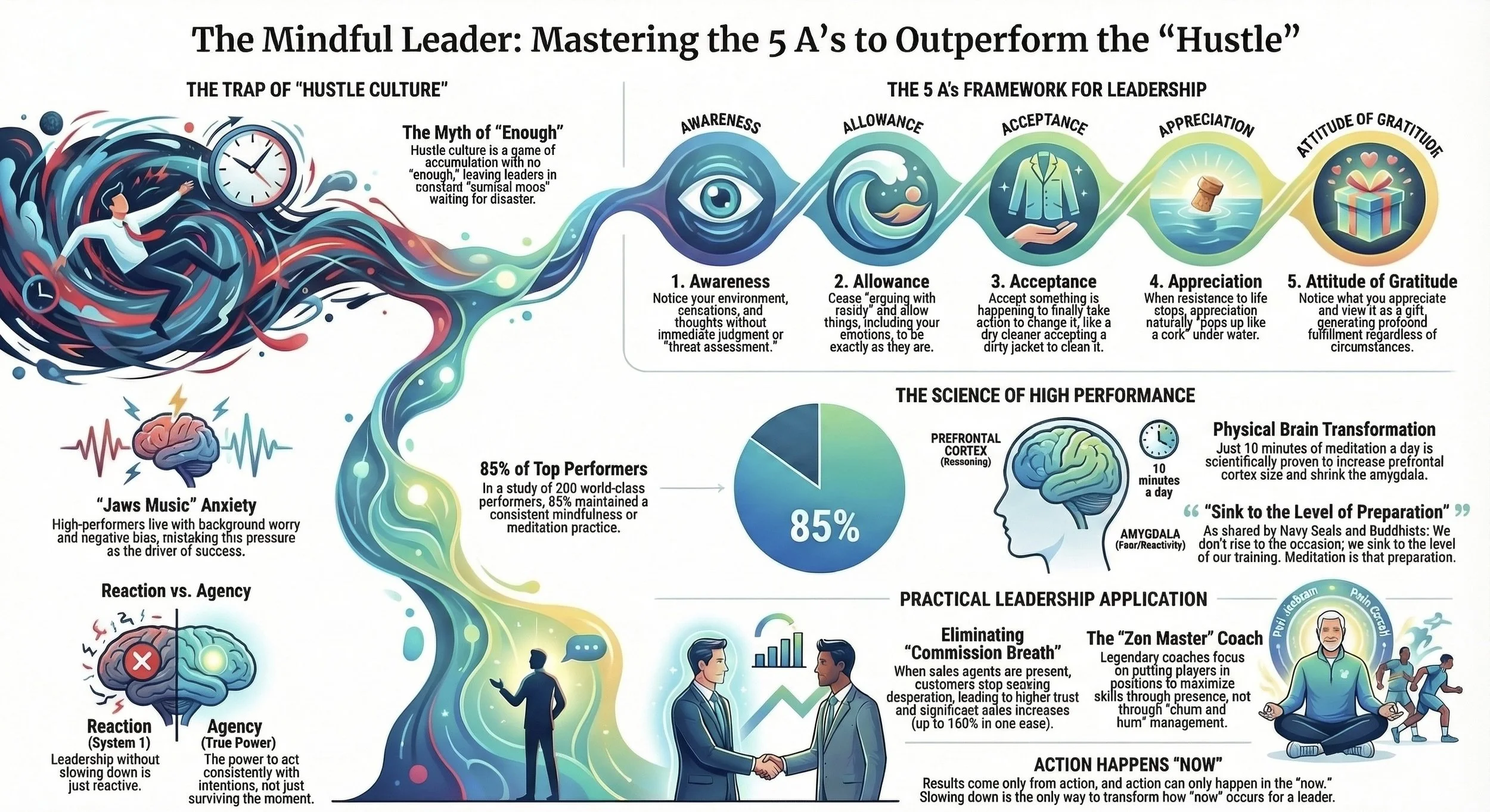
The "Jaws Music" of Success: Why Your Hustle is a Survival Reflex—and How to Break It
You have five deals in escrow. Your family is healthy, you are in a beautiful location, and by every external metric, you are winning. Yet, in the background of your life, the "Jaws music"is playing. It is that low-frequency hum of anxiety—the feeling that you are constantly waiting for the other shoe to drop. For many high-performers, this isn't just a phase; it’s a lifestyle. Growing up as a New York Jew, my family motto was: "Things are never so bad they can't get worse." It’s a survival reflex that keeps you scanning the horizon for the next disaster even when you’re standing in paradise.
We are trapped in the "game of enough," a psychological treadmill where we believe that more revenue or more accolades will finally buy us peace. But here is the cold truth: there is no "top" to the mountain of enough. This hustle is an automatic survival mechanism, not a strategy. On your deathbed, you aren't going to wish you closed that merger; you’re going to wish you hadn't been "time-traveling" through your children's soccer games because you were too busy worrying about a client you might lose. To find true agency, you must move from automatic reaction to conscious presence.
1. Meditation is Brain Training, Not "Soft" Relaxation
The "gratitude journal" is the most overused—and misunderstood—tool in the executive toolkit. If you think mindfulness is about "finding your zen" or sitting cross-legged to relax, you’ve missed the point entirely. For the high-performer, mindfulness is a rigorous performance tool. It is neurological weightlifting.
Scientific data shows that just ten minutes of daily practice literally reshapes your biology, strengthening the prefrontal cortex (your command center) while shrinking the amygdala(your panic button). When an elite athlete like Steph Curry or a coach like Mike McDonald says the "game slowed down," they aren't describing a miracle; they are describing a brain that has been trained to remain responsive rather than reactive.
"We don’t rise to the occasion. We sink to the level of our preparation."
This is why 85% of top performers featured in Tim Ferriss’s Tools of Titans maintain a consistent practice. They aren't doing it to be "soft." They are doing it because they know that working frantic and chaotic is a lie. You don't work better under pressure; you work better when you’ve trained yourself to remain calm while the pressure is on.
2. Stop Putting "Icing on Dog S***" (The Five A's Framework)
Most "positive thinking" is actually spiritual bypassing. You cannot spray perfume on a pile of problems and expect it to smell like roses. I call this putting "icing on dog s*."** If you are suppressing grief, frustration, or fear while forcing yourself to write down "three things I’m grateful for," you are lying to your nervous system.
To experience authentic gratitude, you must move through the Five A's:
Awareness: Noticing the data of your life without labeling it "good" or "bad."
Allowance: This is about your internal world. It means no longer arguing with your emotions. If you are upset, allow yourself to be upset. The lie "I shouldn't be this upset" is what gives the emotion its power.
Acceptance: This is about the external facts. It is acknowledging exactly what is happening in reality without resistance.
Appreciation: Noticing the qualities of the moment.
Attitude of Gratitude: Viewing what you appreciate as a gift.
Most leaders skip the first three steps. But remember: Whatever you resist, persists. When you finally stop holding the cork underwater through resistance, Appreciation pops to the surface naturally. You don't have to manufacture it; you just have to stop fighting reality.
3. Acceptance is Not Agreement (The "Dirty Jacket" Principle)
The biggest barrier to leadership is the belief that accepting a situation means you approve of it. This is a fatal executive error. Acceptance is the prerequisite for change.
Consider the "dirty jacket" at the dry cleaners: the cleaner can "allow" you in the shop, but they can't do a damn thing for the garment until they accept the jacket from your hands. You cannot transform a reality that you refuse to acknowledge.
This applies to the most "unacceptable" situations imaginable—including the systemic failures and horrors revealed in the Epstein files. Morally, those actions are unacceptable. But until we accept the fact that they are happening, we have zero agency to stop them. A leader who denies the current state of their team or their industry is a leader with no power. You must accept the "is-ness" of the situation before you can lead anyone out of it.
4. The 160% Revenue Lift of "Presence"
Presence isn't just a "vibe"; it’s a revenue driver. In sales, we call the opposite "Commission Breath." It’s that palpable, desperate need for a specific outcome. Clients can smell it, and it instinctively repels them. When you are living in a future where you "need" the deal to close, you aren't actually in the room with the person across from you.
When I trained my real estate team to let go of the "need" and focus on being "okay" in the present moment, we saw a 160% increase in sales. This happened because when a leader or salesperson is truly present, they create biological trust.
"When you relax and trust the moment, you know what your customer does? They relax and trust you."
By dropping the survival reflex, you become available to actually hear what the customer wants, rather than just waiting for your turn to speak.
5. The Power of the "Micro-Practice"
The mind is a time-traveler, constantly fleeing to the past (regret) or the future (worry). Your body, however, is always in the present. To interrupt "Mind Time-Travel," you need grounding micro-practices.
Box Breathing is the gold standard used by Navy SEALs. Inhale for 4 seconds, hold for 4, exhale for 4, and hold for 4. Do this for sixty seconds before you walk into a pitch or before you walk through your front door at the end of the day. It resets your nervous system from "threat" to "presence."
Feet on the Floor is a simple grounding exercise. When the "Jaws music" starts to swell, shift your entire focus to the physical sensation of your feet touching the ground. Don't judge the feeling; just experience the data. This simple shift pulls your attention out of the imaginary future and back into the only place where action can actually occur.
Conclusion: The Challenge to Slow Down
The world is currently facing a massive deficit of leadership, and it starts with the individual’s inability to slow down and look around. We have been trained to believe that speed equals results, but doing the same thing over and over and expecting different results is the literal definition of insanity.
If you want new results, you need new actions. And because the only time you can ever act is Now, you must transform how "Now" occurs for you. This requires the courage to stop the "survival reflex" long enough to see what is actually in front of you.
If you stopped resisting how your life looks right now, what gifts would suddenly pop to the surface?