
Why Your Success is a Hiding Place: Redefining Leadership Through the Principle of Exchange
In the rarified air of high achievement, the resume is often treated as a proxy for the soul. We look at the military service, the grueling Iron Man finishes, and the businesses sculpted from a napkin to $3 million in private equity funding. To the outside observer, these are the artifacts of a triumph. To the high-performer standing in the wreckage of that $3 million collapse, however, the view is different.
The modern corporate apparatus is obsessed with the mechanics of the "how," yet remains dangerously illiterate regarding the "who" behind the wheel. We see leaders who look formidable on paper but feel "exhausted, numb, or restless" in private. They have optimized the external world while remaining internally fractured. This disconnect is not a failure of strategy; it is a crisis of identity. To lead with genuine authority, one must acknowledge a difficult truth: for the driven, success is often the most effective place to hide.
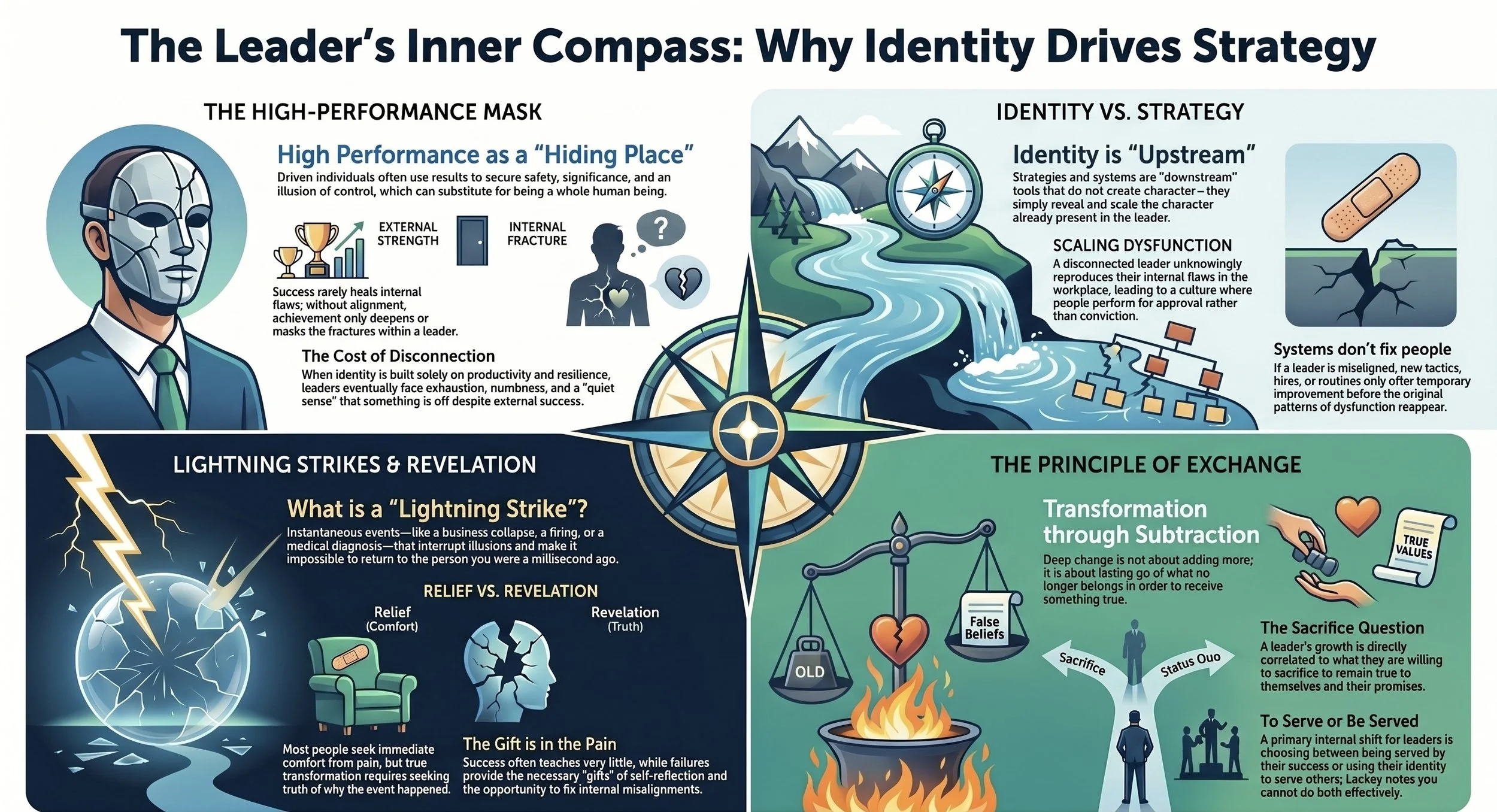
High Performance as a Highly Effective Hiding Place
For the ambitious, productivity is rarely just a metric—it is a sanctuary. We learn early that results provide a fortress of safety and a steady stream of significance. High performance creates an illusion of control that masks internal instability.
When we build our identity around capabilities, usefulness, and resilience, these traits become a substitute for being a whole human being. The world rewards output, but it rarely pauses to interrogate the internal alignment of the producer. We scale our responsibility and our achievements, yet we use those very successes to avoid the quiet sense that something is off.
"High performance becomes a highly effective hiding place for us or anybody... we build that identity around what we call our capabilities, our usefulness, our productivity, our resilience. The problem is that those things... become a substitute for you being whole as a human."
Identity is Upstream, Strategy is Downstream
There is a fundamental misunderstanding in contemporary leadership: the belief that a better system can fix a broken person. In reality, identity is "upstream," and strategy is "downstream." Systems do not create character; they reveal it.
If a leader lacks internal alignment, their systems will merely scale their dysfunction. You can see this in the difference between a culture of conviction and a culture of approval. In a dysfunctional organization, employees perform to seek the leader's favor rather than working from a shared belief. Contrast this with an organization like Chick-fil-A; the enthusiasm found in their drive-thrus isn't the result of a better manual, but of management alignment that flows from the top down.
When leaders fail to address who they are, they remain trapped in "symptom management." They cycle through new hires, new operating systems, and new tactics—a process that is often incestuous and ultimately futile. Strategy cannot protect an organization from a leader’s internal failings; those fractures will eventually show up in the metrics, the culture, and the trust of the team.
The Principle of Exchange: The Power of Subtraction
Transformation is rarely an additive process. It is not about adopting a new morning routine or a fresh set of goals. Instead, it is governed by the Principle of Exchange.
This principle, crystallized during the brutal requirements of Iron Man training, dictates that to move forward, one must let go of something false to receive something true. It is a literal trade of resources. Training for an Iron Man requires the exchange of six days a week—a massive sacrifice of time. In leadership and life, the question is the same: What are you willing to sacrifice?
Real change is about subtraction. You cannot carry the false, performative versions of yourself into the next stage of maturity. You must trade the comfort of your existing illusions for the weight of your actual identity.
Lightning Strikes as Revelations, Not Just Interruptions
Life eventually delivers "lightning strikes"—instantaneous moments that interrupt your trajectory. These are the catastrophic failures, the $3 million collapses, the betrayals, or the medical diagnoses that strip away the person you were a millisecond ago.
While the natural instinct is to seek relief—to numb the pain with food, drink, travel, or increased busyness—the strategist’s path is to seek revelation.
Relief is about comfort and escaping the discomfort of the "whispers" in your head.
Revelation is an invitation to examine the wreckage and stop taking things forward that no longer serve you.
Success often teaches nothing, but failure provides the gifts we actually need. These crises are not merely painful interruptions; they are revealer moments that expose the fragility of our internal alignment.
To Change the World, Stop Trying to Change the World
There is a profound shift that occurs when a leader moves from outward ambition to inward reconciliation. Many spend their lives trying to change the world as a way to avoid changing themselves, only to realize they are carrying their own dysfunction into every project they touch.
"I once went out into the world to change the world and then I became wise and decided I would change me."
When you fix yourself first, you change the world by default. The version of you that is aligned and whole is the most significant gift you can offer your enterprise. Conversely, a leader who refuses self-reflection will reproduce their own internal flaws in the workplace, creating a "culturally fragile" environment that cannot sustain long-term pressure.
The Mirage of External Affirmation
We often treat status symbols—the houses, the cars, the specific professional circles—as proof that we have "arrived." This is a dark pursuit. It is rooted in the belief that we are not enough as we are, and that we require "people, places, and things" to affirm our value.
True alignment is reached only when you are enough for yourself, regardless of the job. Whether you are leading a multi-million dollar corporation or digging a ditch, your value must be independent of your output. When you no longer need to be served by your success, you finally become free to truly serve others. The filter changes from What can I get? to Who can I be?
Conclusion: A Call to Stillness and Alignment
If you have a quiet sense that something is off, stop dismissing it. You cannot outrun your internal voice through productivity; busyness is merely radio static used to drown out the truth.
The hardest work you will ever do is sitting with the discomfort and asking: What is this pain trying to show me? Leadership requires the courage to stop the "performance" and reconcile the two tracks of your life.
As you evaluate your current trajectory, ask yourself the defining question of internal strategy: Is the life you are building actually connected with who you really are, or are you running on two different tracks toward two different destinations? Alignment is the only way to ensure that when you finally arrive, you are actually there to inhabit the result.