
Why the "Cloud" is More Fragile Than You Think: 5 Shifts Redefining Data in the AI Age
The Architecture of Overconfidence
We navigate our digital lives with an unearned sense of security. We assume our banking apps will sync, our schools will remain online, and our remote work hubs will be waiting for us at 9:00 AM. But as any "System Thinker" will tell you, this seamless experience is an illusion maintained by an alarmingly narrow foundation.
The urgency of this fragility cannot be overstated. In the last five years alone, humanity has generated more data than in the previous twenty years combined. This explosion—driven by AI training, IoT, and edge devices—is being funneled into an aging, centralized infrastructure that was never designed to handle this level of volume or volatility. We aren’t just building on a narrow foundation; we are building a skyscraper on a toothpick.
The 65% Trap: Concentration as a Geopolitical Hazard
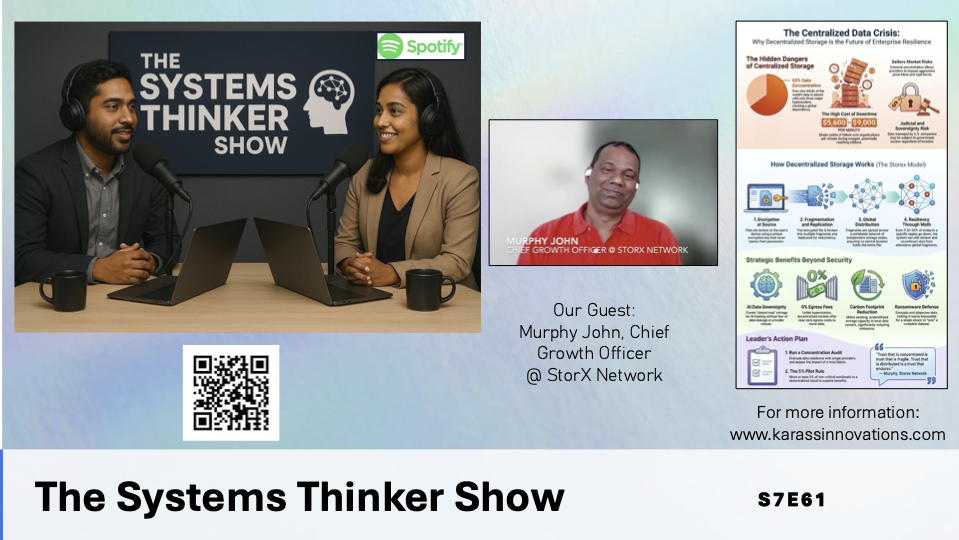
Modern data storage is defined by a dangerous paradox: the more data we create, the more we concentrate it. Today, three major hyperscalers control approximately 65% of the world’s data. This creates a "single point of failure" on a global scale, where a localized technical glitch becomes a worldwide crisis.
The risk isn't theoretical. Look back to the massive hyperscaler failure in October of last year: a single outage in a specific zone created immediate havoc, freezing banking systems and locking students out of critical learning platforms. When 65% of the world's digital "brain" is held by three entities, those entities stop being service providers and start being systemic risks.
"If any of these have a problem even in a specific zone, it would be very catastrophic and it would create havoc in our life. You have banks which stop working, you have schools that stop working... we are dependent on these few service providers." — Murphy
The $9,000-Per-Minute Exposure
For the modern enterprise, the "Seller’s Market" created by this concentration is an economic ticking time bomb. Because hyperscalers hold such a dominant position, they dictate terms, hike prices, and trap users with exorbitant "egress fees"—the cost of simply moving your own data out of their ecosystem.
When this centralized architecture fails, the financial bleeding is instantaneous. Industry data shows the cost of downtime for an enterprise ranges from $5,600 to $9,000 per minute. Beyond the immediate loss of productivity, a strategist must account for:
Reputation Damage: The permanent erosion of customer trust when services go dark.
Compliance Penalties: Legal fines for data unavailability in highly regulated sectors.
Judicial Risk & The Cloud Act: A critical oversight for global firms is the US Cloud Act, which allows the US government to access data held by US companies even if that data is physically stored on foreign soil.
Rising Insurance Premiums: Each failure makes business interruption insurance more expensive and harder to secure.
Flipping the Script: Data Fragmentation vs. The Ransomware Business Model
Ransomware is effective because it exploits the fundamental flaw of centralized storage: data concentration. To a bad actor, a centralized server is a honeypot. If you can find the location, you can lock the entire dataset.
The shift toward decentralization, pioneered by platforms like Storex, flips this equation by making data "resilient and unaware." The process moves from concentration to fragmentation:
Encryption at Source: Files are locked with a unique key held only by the user—not the provider—before they ever leave the device.
Fragmentation: The encrypted file is shattered into fragments.
Global Distribution: These fragments are replicated and spread across a worldwide network of independent storage nodes.
In this model, no single node or device has access to a complete file. If a network attack or physical disaster takes out a dozen nodes, the system simply fetches fragments from others. You aren't just defending your data; you are making it impossible to target.
The AI Sovereignty Crisis and the "Green" Storage Alternative
The AI boom has introduced a new anxiety: the "proprietary brain" drain. Enterprises are increasingly wary that storing their trade secrets or specialized datasets on hyperscale clouds will result in that data being used to train Large Language Models (LLMs) without their consent. This has sparked a move toward "closed-loop storage"—private, decentralized networks where AI models can be trained on proprietary data without it ever leaking into the public domain.
Furthermore, the environmental cost of traditional data centers is becoming a boardroom priority. Unlike hyperscalers that build massive, energy-hungry facilities, the decentralized model utilizes the "circular economy" of IT—harnessing underutilized existing infrastructure. By leveraging existing nodes, organizations can significantly reduce their carbon footprint while eliminating egress costs entirely.
Reflective Question: As AI scales, who holds your encryption keys, and who is actually "auditing" the eyes that see your data?
The Mindset Pivot: Trusting Mathematics Over Organizations
The greatest barrier to a more resilient infrastructure isn't technology—it’s a mindset issue. For 25 years, we have been conditioned to trust brands. We believe data is safe because a company’s name is on the building. However, the next era of infrastructure demands a shift from trusting organizations to trusting open-source architecture and cryptographic guarantees.
A strategist trusts what can be audited. By moving to an entirely open-source, decentralized framework, organizations move away from "blind trust" in a service provider’s promises and toward mathematical certainty. We are moving from a world of "trust us" to a world of "verify the code."
"Trust that is concentrated is trust that is fragile. Trust that is distributed is a trust that endures."
Conclusion: A Strategic Audit for the Future
To survive an era of AI-powered attacks and geopolitical volatility, leaders must stop viewing storage as a commodity and start treating it as a strategic asset. The days of "set it and forget it" cloud strategy are over.
Every C-suite should immediately conduct a Concentration Audit:
What percentage of your mission-critical data resides with a single provider or in a single geographic zone?
What is your "Judicial Risk" exposure under laws like the Cloud Act?
Have you piloted decentralized workloads (even at 5% of your total data) to test resiliency?
If your primary storage provider went dark today, how many minutes could your business survive at $9,000 each? The answer to that question should determine your infrastructure strategy for the next decade.