
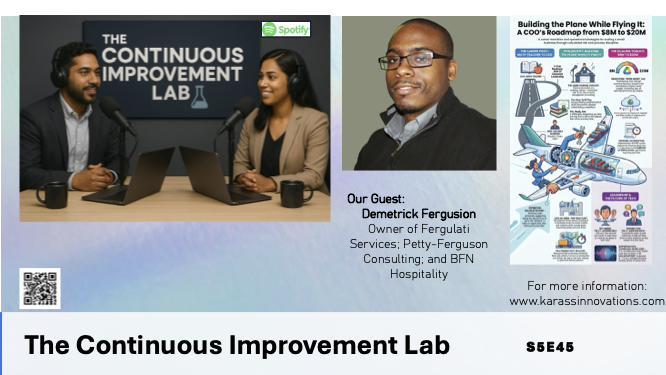
Building the Plane While Flying It: 5 Counter-Intuitive Lessons from a $20M Growth Journey
In the classroom, mathematics is the study of certainty. As a former math teacher, I spent my early career navigating a world of proofs and predictable variables. But scaling a construction enterprise from $8 million to $20 million in revenue taught me a different kind of logic: the logic of calculated chaos. In business, you don't always have the luxury of solving for X before you move to the next step. Often, you have to build the plane while it’s already in the air.
Transitioning from education to management consulting—fueled by a reading list that began with Eliyahu Goldratt’s The Goal and a Green Belt in Lean Six Sigma—I realized that growth is not about waiting for perfect conditions. It is an expeditionary process. For leaders stalled by the fear of the next leap, these five counter-intuitive lessons from the front lines of operational scaling offer a blueprint for executing under pressure.
1. Forget "Ready, Aim, Fire"—Try "Fire, Ready, Aim"
Traditional business schools preach a linear progression: prepare, target, then execute. In a high-growth environment, this is a recipe for analysis paralysis. To move at the speed of a $20M enterprise, you must be willing to "fire" first to get in the ballpark.
I learned this from a co-owner who had a radical appetite for risk. One Sunday night at 7:00 PM, he called me with a bizarre question: "Do you know how to sell paper?" He had found a container of printer paper at half the market price and bought it on the spot. He didn’t have a buyer, a distribution plan, or even a reason to be in the paper business. But he fired. Three weeks later, he flipped that container for a 3x profit.
The logic is simple: your experience and repetitions provide the intuition needed to take the shot. Once the shot is fired, you see where it lands. That is your data point. Only then do you "ready" your resources and "aim" for the follow-up with precision.
"If there's a threat coming or if there's an opportunity coming, just fire. You're going to get in the ballpark. And then once you figure out where you hit, you ready and then you fire again."
2. Redefining the "Worst-Case Scenario"
Most leaders are paralyzed by what they might lose. A clinical strategy columnist looks at what they stand to gain even in "failure." When I was offered a COO role, the risk was significant. I could have stayed in a comfortable consulting gig. But I looked at the math of the career leap and realized that the floor of my failure was higher than the ceiling of my current position.
If I took the COO role and was fired a year later, the "worst-case" was that I still had the title of COO on my resume and a year of high-level operational experience to leverage. That "failure" would still put me ahead of where I started. When you realize that the professional capital gained from taking a risk outweighs the cost of a temporary setback, the risk becomes mandatory.
3. Breaking the 4.5-Hour Productivity Wall
Operational excellence requires a brutal confrontation with the "4.5-hour wall." My Lean Six Sigma training revealed a sobering data point in residential installation and delivery: in an eight-hour day, a fleet only averages about 4.5 hours of actual productivity. The rest is swallowed by road time and logistics.
To scale from $8M to $20M, we had to optimize those 4.5 hours with surgical precision. We didn't just guess; we applied specific operational levers:
The 2.2x Rule: We implemented morning startup checklists because our data showed that a return trip to the shop for a forgotten bracket or sink cost 2.2 times more than the original job. One error could erase the entire profit margin of a project.
One-Piece Flow: We redesigned the factory floor with a "Southwest to Northeast" flow. By ensuring that no materials or forklifts crossed paths, we increased safety and maximized Overall Equipment Effectiveness (OEE).
The Tech Progression: We didn't jump into a million-dollar ERP immediately. We scaled the technology as we scaled the revenue, moving from Google Drive to Zapier-based automations, and finally to a full ERP that eliminated invoicing lag. We went from a three-day delay to same-day invoicing, which is the lifeblood of cash flow during rapid growth.
4. Accepting "AI Hallucination" as a Standard Error Rate
Leaders who wait for "perfect" technology are falling further behind every minute. Today, that means accepting the 7% error rate of Artificial Intelligence. Many executives dismiss AI because of "hallucinations," yet they ignore the standard "human hallucinations" they already pay for: smoke breaks, office gossip, and bathroom breaks.
In the world of OEE and adherence percentages, we already factor in human inefficiency. AI is no different. If an AI system operates at 100x the speed of a human with a 7% error rate, it is an exponential win. Once you build the process to audit those errors, the technology becomes unstoppable.
"Technology doesn't lose... once a new technology comes in and it's got trustability, that's it. The world has changed from that point forward."
5. The 3-to-1 Rule for Rapid Career Growth
Growth isn’t just about systems; it’s about influence. I credit my grandmother’s wisdom for one of my most effective business tactics: "You have two ears and one mouth for a reason."
In a high-growth company, the most valuable currency is curiosity. I advise anyone looking to scale their career to adopt the 3-to-1 Rule: ask three times as many questions as you answer every day. For an emerging leader, this creates "indirect influence." By asking intelligent, relentless questions, you force the leadership above you to think deeper. Eventually, they will stop just answering your questions and start asking for your input. This is how you gain merit-based experience faster than your peers.
Conclusion: The Pilgrimage of the New Leader
Scaling a business is a pilgrimage into the unknown. It requires the heart of a teacher and the discipline of a consultant. Whether you are automating your invoicing through Zapier, redesigning a factory flow to prevent crossing paths, or taking a high-stakes role that scares you, you must accept that technology and risk are winning bets.
Stagnation is the only true failure. As you look at your own operations, ask yourself: Are you stalled by the fear of a migration error, or are you ready to pull the trigger and build your plane in the air?