
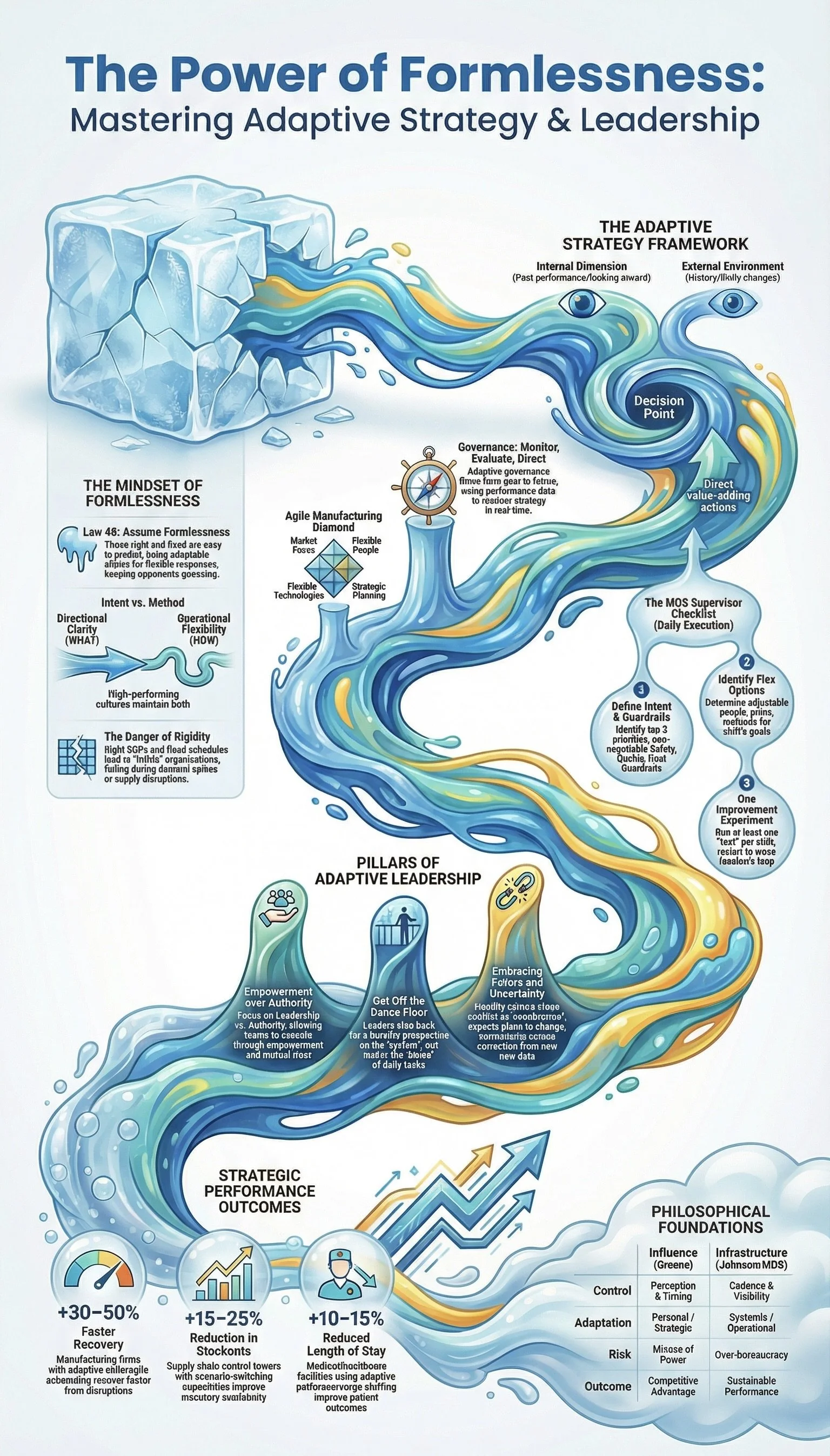
The Formless Advantage: Why the Most Resilient Leaders are Impossible to Pin Down
In an era defined by volatile demand, labor constraints, and cascading supplier disruptions, the greatest threat to an organization isn’t a lack of discipline—it is rigidity. Standard Operating Procedures were designed as armor; in today’s volatility, they have become a straitjacket. Many organizations operate as "brittle" systems: they are highly optimized and efficient under laboratory conditions, but they shatter the moment reality diverges from the plan.
To survive, modern leadership must shift toward "Formlessness." This is not an invitation to chaos, but a transition to a superior form of disciplined flexibility. It is the art of maintaining an absolute certainty of intent while remaining entirely fluid in method.
1. Formlessness is a Strategic Weapon, Not Chaos
Adopting the philosophy of Robert Greene’s "Law 48" allows an organization to become unpredictable to competitors and highly responsive to its environment. When a leader or a company is "rigid and fixed," they become easy targets. They are easy to predict, easy to counter, and dangerously slow to pivot.
"Those who are rigid and fixed are easy to predict and counter. By remaining formless and adaptable, you can respond to any situation with flexibility. This makes it difficult for opponents to anticipate your next move, keeping you one step ahead in the game of power." — Robert Greene, Law 48
Strategic formlessness suggests that "looseness of method" actually protects the "certainty of intent." By refusing to be wedded to a single tactic, a leader ensures that the ultimate objective is met regardless of the obstacles that appear. In the game of power and market share, the most dangerous opponent is the one you cannot pin down.
2. The "Guardrail" Framework for True Flexibility
While Greene provides the philosophical influence, achieving formlessness at scale requires an operational infrastructure. As noted in the comparison between Robert Greene and Lenier Johnson, power without systems fades, and systems without adaptability calcify. True resilience requires a Management Operating System (MOS) that defines the non-negotiables—the "Guardrails"—so that everything else can flex.
By identifying "Flex Options" (changes in People, Plan, or Method), teams can navigate volatility without falling into disorder.
Dimension
Rigid Vehicle (Static)
Formless Vehicle (Adaptive)
Strategy & Method
Static SOPs: Methods are fixed regardless of context.
Guardrails + Judgment: Teams use expertise within safe boundaries.
Planning
Fixed Schedules: Plans are made months in advance and resisted.
Scenario Switching: Tactics shift based on real-time demand.
Quality
Compliance-Focused: Rigid adherence to outdated steps.
Outcome-Focused: Adaptive standards that prioritize safety and integrity.
Cost
Annual Budgets: Financial plans are locked and inflexible.
Dynamic Reforecast: Resources move where they provide the most value.
3. Moving Authority to the Information: The Rise of Response Cells
A hallmark of adaptive leadership is the realization that "Decision Velocity" is a primary competitive advantage. To achieve this, authority must move to where the information lives. In a formless organization, "escalation rights" are pushed closer to the work, allowing for a timely response to issues as they arise.
This requires the formation of Response Cells—cross-functional teams that coalesce around a disruption. In these cells, authority rotates based on expertise rather than static titles. For example, if a plant faces process instability, engineering takes the lead; if the crisis shifts to a shortage of materials, the supply chain assumes command. This decentralized "mission command" model relies on empathy, mutual trust, and the empowerment of frontline teams to execute.
4. The Power of the "Rolling Horizon"
The "Adaptive Strategy" model emphasizes that looking outward at likely changes is more important than clinging to history. Organizations that have successfully transitioned to formlessness move away from fixed annual plans toward rolling 2-week horizons.
At the heart of this is the "Decision Point" loop: a continuous cycle of Monitor, Evaluate, and Direct. This shift is supported by "Learning Loops." Instead of post-hoc explanations for missed goals, teams engage in daily experiments, documenting "what changed and why." This feedback loop ensures the organization is constantly adjusting its "Internal Dimension" (Looking Inward) to match the "External Context" (Looking Outward).
5. Resilience is Measurable: The Data Proof
The move toward optionality—the ability to choose between different paths as a situation unfolds—is the new currency of modern economics. Unlike the "Change Management" theories of the past—where Kurt Lewin sought to "refreeze" organizations or John Kotter focused on urgency—the formless approach prioritizes systemic execution. The results are quantifiable:
• Manufacturing: Firms using adaptive cells and agile scheduling recover from disruptions 30–50% faster.
• Engineering: Modular architectures and digital twins reduce time-to-stable by 20–40%.
• Warehousing: Dynamic labor allocation and demand-based slotting improve pick rates by 8–15%.
• Supply Chain: Control towers with scenario switching reduce stockouts by 15–25%.
• Medical/Healthcare: Adaptive pathways have reduced patient length of stay by 10–15%.
6. The "Get Off the Dance Floor" Mindset
Adaptive leadership requires the ability to "get off the dance floor" to see the entire system from the balcony. This perspective, championed by systems thinkers like Peter Senge and infrastructure experts like Lenier Johnson, allows leaders to see the "whole system" rather than just the immediate task.
To maintain formlessness, leaders must embrace twelve specific traits—including Embracing Failure, Constructive Conflict, and Diversity—to prevent the culture from calcifying into old habits. It is the MOS infrastructure that creates the "safe space" for this strategic influence to occur.
"Formlessness is not disorder. The strongest cultures blend clarity of purpose with freedom of method. Power without systems fades; systems without adaptability calcify. The winning formula is disciplined flexibility." — Final Reflection, Organizational Strategy Case Study
Conclusion: The Winning Formula for the Future
The future belongs to the "Disciplined Flexible." While standardization provides a baseline for performance, it is the ability to assume formlessness that provides the competitive edge. As change management gurus have long argued, the human element is vital, but without an MOS to anchor the transition, resilience is merely a buzzword.
Final Thought-Provoking Question: Identify one rigid "form" or process in your organization that was designed for a world that no longer exists. If you removed that constraint and replaced it with a "Guardrail," how much faster could your team move?