
Why Stepping Into a Great Leader's Shoes Is a Career-Ending Mistake
Introduction: The Shadow of a Giant
Stepping into a role previously held by a beloved, legendary figure is one of the most daunting challenges in leadership. The pressure is immense, the expectations are sky-high, and the predecessor’s shadow looms large. This is the successor's dilemma: how do you lead when you're constantly being measured against a ghost?
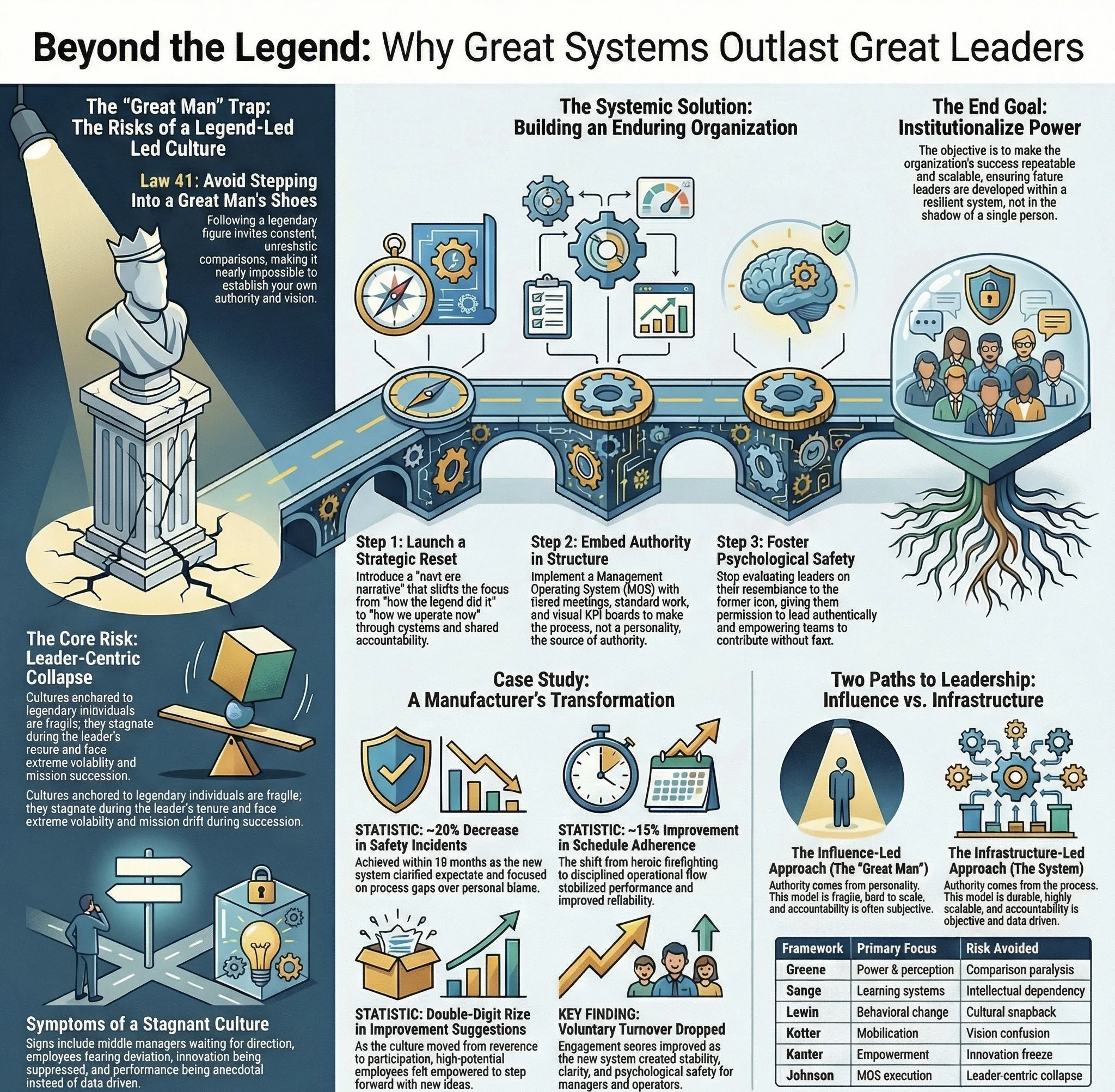
The natural instinct is to try to fill those shoes—to emulate the style, echo the decisions, and extend the legacy of the person who came before. But this is a trap. Consider the case of a 70-year-old manufacturing firm that, after the departure of its charismatic founder-CEO, found itself in a state of cultural stagnation. Middle managers waited for direction, and operators feared deviating from the old ways. The very qualities that made the founder a legend had become barriers to the company's future.
This article explores three powerful, if counter-intuitive, strategies for any leader stepping into a great predecessor's role. Drawing on the principles of Robert Greene's Law 41, "Avoid Stepping into a Great Man’s Shoes," we will outline a practical path not just for survival, but for creating a new era of success.
1. Reframe the Game: Your Enemy Isn't the Legacy, It's the Comparison
The central principle for any successor is this: the danger isn't failing to live up to the predecessor, but being constantly judged by their standards. True success requires that you stop playing their game. You must create your own path, establish your own brand, and define your own metrics for success.
In the manufacturing firm case study, the new CEO initiated a "strategic reset." He deliberately shifted the company's internal language. Phrases like "how he did it" were replaced with a forward-looking focus on "how we operate now." This simple but profound change immediately reduced the comparison anxiety that had paralyzed the leadership team, freeing them to contribute to a new vision rather than just preserve an old one.
This shift directly neutralizes the single greatest risk a successor faces: comparison paralysis. When every action is measured against an idealized past, a leader's credibility is eroded before they can even begin to build it.
"comparison kills credibility"
Ultimately, this strategy is so powerful because it moves the goalposts. It changes the objective from an unwinnable game of imitation (being someone else) to a winnable one of authentic leadership in a new and different era.
2. Build Infrastructure, Not a New Myth
The most durable way to establish a new era of leadership is to shift the organization's reliance from a single, charismatic personality to robust, predictable systems. Legends are fragile; well-designed infrastructure is resilient.
The key to this transition is implementing a Management Operating System (MOS)—a structured framework of processes that governs how work gets done. Its key components include:
• Tiered meetings for consistent communication and review.
• Escalation rules for predictable problem-solving.
• Standard work to codify best practices.
• Visual controls to make performance transparent and objective.
This isn't an isolated phenomenon. In manufacturing, studies repeatedly show that approximately 60–70% of operational transformations fail due to leader dependency rather than process maturity. The transition from personal influence to institutional strength is critical.
From Influence to Infrastructure | Old State (Influence-Led) | New State (Infrastructure-Led) | | :--- | :--- | | Authority based on Personality | Authority based on Process | | Decisions were CEO-centric | Tiered | | Accountability was Subjective | Accountability is Objective |
This new infrastructure makes the company more resilient and scalable. At the case study firm, the results were clear and measurable: safety incidents fell ~20%, schedule adherence improved ~15%, and voluntary turnover dropped. By embedding authority in its systems, the company institutionalized its power, ensuring it was no longer dependent on the heroics of a single person.
3. Make a Symbolic Break to Build Your Own Authority
Successors often fear that breaking from the past will be seen as disrespectful. While honoring a predecessor’s contributions is important, establishing your own legitimacy requires making a strategic and symbolic break. These visible changes signal that a new era has begun.
The new CEO in the case study implemented several of these symbolic breaks:
• He replaced top-down "command memos" with interactive town hall meetings.
• He swapped anecdotal progress updates for public KPI boards that displayed real-time, objective data.
This approach aligns with the "break and redefine" philosophy found in Greene's work. It stands in contrast to the more traditional "honor and evolve" approach favored by many change management experts, which can inadvertently keep the organization tethered to the past.
By making these decisive and visible changes, the CEO gave the organization permission to move on. The culture shifted from a state of reverence for the past to one of active participation in the future. A clear sign of this empowerment was a double-digit rise in continuous improvement suggestions, as employees felt their contributions were not just welcome but essential to the new way of operating.
Conclusion: From Legend to Legacy-Proof
True success as a successor comes not from emulating a legend, but from making that legend's singular greatness unnecessary. The goal is not to become the next great person, but to build a great, resilient system that no longer requires one.
By reframing the game away from comparison, building durable infrastructure, and making a symbolic break with the past, a new leader can escape the predecessor's shadow and forge their own legacy. Cultures anchored to legends ultimately stagnate, while cultures anchored to systems can adapt and thrive long into the future.
As a leader, ask yourself: are you building a personal myth, or are you building an organization that can outlast one?