
The "Meeting-Action" Paradox
In the theater of modern business, few scenes are more common—or more deceptive—than the high-energy team huddle. A group of talented professionals identifies a critical bottleneck, aligns on a solution, and leaves the room feeling a profound sense of accomplishment. Yet, two weeks later, that same bottleneck remains, effectively calcified. This is the "Meeting-Action" Paradox: the phenomenon where robust communication fails to catalyze real-world change.
As a consultant, I often see organizations invest millions in a Management Operating System (MOS) to structure their workflows, only to watch that investment evaporate through "execution debt." The hard truth is that even the most sophisticated MOS is functionally worthless without a specific, unrelenting rigor. Organizational excellence isn't forged during the discussion; it is secured in the "close."
The High Cost of the "Open Loop"
A pervasive leadership fallacy is the belief that identifying a problem is synonymous with solving it. When a task is discussed but not formally tracked to its conclusion, the organization suffers from "operational leakage"—a steady drain of mental energy and physical resources on recurring issues. These "open loops" create a culture of stagnation where the same fires are fought daily.
The fundamental directive for any leader seeking to plug these leaks is absolute:
"A solid MOS breaks down without follow-up. Ensure action items from every meeting are logged, tracked, and closed."
Without this follow-up, the MOS becomes a performative ritual rather than an engine for growth. Capturing value requires moving beyond the "what" and "how" to ensure the "done" is verified and logged.
The "20% Rule" and Capacity Liberation
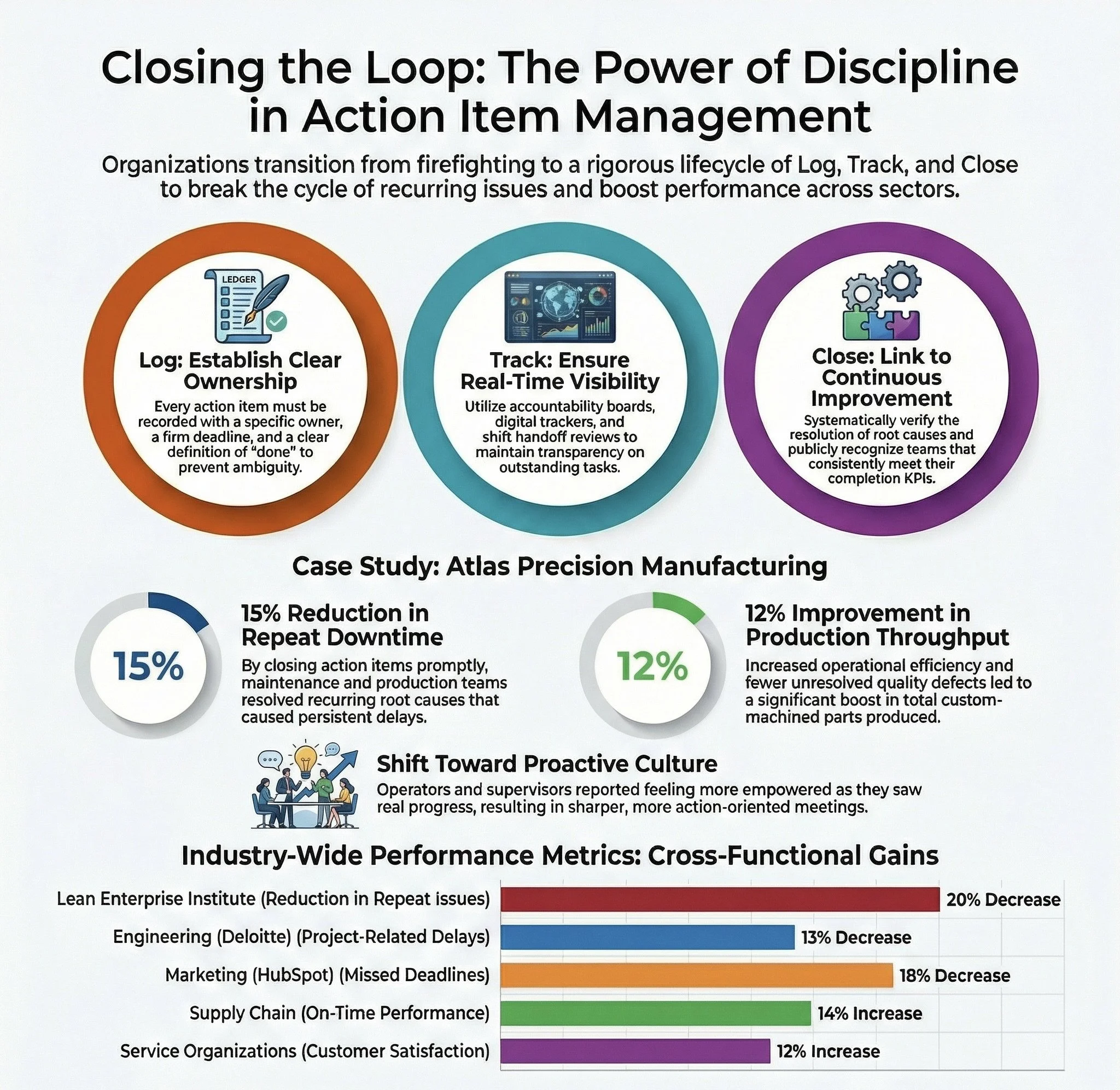
The business case for closing discipline is anchored in hard data. Research from the Lean Enterprise Institute reveals that organizations implementing formal action-tracking processes realize a 20% reduction in repeat issues and a 15% improvement in overall resolution rates.
Solving the "Productivity Killer"
In industrial and logistics environments, "repeat issues" are the ultimate productivity killer. When a team solves the same problem twice, they aren't just wasting time; they are burning capital.
The Logic of Capacity Liberation
By driving a 15% improvement in resolution rates, a company is essentially engaging in "Capacity Liberation." When you stop re-litigating old problems, you "find" hidden capacity within your existing workforce without the need for additional headcount. Structured closure transforms temporary fixes into permanent operational gains.
Case Study: How Atlas Precision Fought "Firefighting"
Atlas Precision Manufacturing, a producer of custom-machined parts, serves as a masterclass in the power of the close. Despite a structured MOS, the company was trapped in a cycle of "firefighting."
The "Before" State: Unresolved Friction
While their daily huddles were structured, action items remained open for weeks. This lack of follow-through manifested as unresolved downtime and delayed maintenance that persisted shift after shift. While quality defects eventually followed, the primary drain was the constant, reactive nature of their maintenance operations.
The Intervention: Transparency and Ownership
Leadership mandated a formal system to log every action item with assigned owners and hard deadlines. They utilized two primary levers:
• Accountability Boards: Physical focal points for shift-to-shift communication.
• Digital Trackers: Real-time visibility for leadership and cross-functional teams.
The "After" State: Measurable Excellence
Within just 60 days of enforcing this discipline during shift handoffs and tiered meetings, Atlas achieved:
• 15% reduction in repeat downtime incidents.
• 12% improvement in production throughput.
• Significant decrease in unplanned overtime.
By solving problems at the source and closing tasks on time, Atlas eliminated the chaos of firefighting and stabilized their operational floor.
A Universal Law of Execution
Action item discipline is often mischaracterized as a "factory floor" requirement. In reality, it is an industry-agnostic leadership trait. The "close" is the only stage in any business process where value is actually realized.
Cross-Industry Benchmarks
• Engineering: Firms tracking items with clear ownership reduce project delays by 13%(Deloitte).
• Supply Chain: Strict closure protocols for process updates lead to a 14% increase in on-time performance.
• Marketing: Structured systems for closing project actions reduce missed deadlines by 18%(HubSpot).
• Service Sectors: Enforcing closure on customer recovery initiatives boosts satisfaction and retention by 12%.
Whether the output is a machined component or a digital marketing campaign, the data confirms a universal truth: Execution is the baseline for excellence, and closure is the baseline for execution.
From Accountability to Empowerment
The transition from "tracking" to "closing" triggers a vital cultural shift. When leadership moves beyond simply identifying problems and begins demanding closure, it eliminates the feeling among staff that they are "shouting into a void."
Building Psychological Safety
When action items are closed, employees see tangible evidence that their feedback leads to change. This creates a virtuous cycle of ownership. By linking completion rates to continuous improvement KPIs and offering public recognition for teams that meet deadlines, leadership fosters a high-trust environment. Transparency tools like MOS dashboards ensure a "single source of truth," removing the friction of uncertainty and the "he-said-she-said" of traditional reporting.
Conclusion: The Future of Execution Excellence
As the business landscape moves toward total digital transparency, the standard for execution is shifting. Digital dashboards and MOS platforms are no longer optional "add-ons"; they are the infrastructure of accountability. They provide the visibility necessary to ensure that no task is "forgotten" and no bottleneck is ignored.
Ultimately, the foundation for sustained productivity is not the brilliance of your strategy, but the consistency of your follow-through. As you audit your own leadership style, you must ask the difficult question: Is your MOS a framework for progress, or simply a ledger of unfulfilled promises?