
Why Your "Big Data" Strategy is Killing Productivity (and How to Fix It)
The Data Overload Trap
Most leaders begin their day buried under 50-page slide decks and exhaustive dashboards, yet they often struggle to answer a fundamental question: Why did we miss our target yesterday? This is the "data drowning" reality of the modern enterprise. We operate under the flawed assumption that volume equals insight, but in practice, excessive data often creates "decision latency" and operational friction. The counter-intuitive truth known to the most effective organizations is that a leaner data set—rooted in integrity and actionability—is the ultimate catalyst for high-velocity decision-making. To reclaim productivity, leadership must pivot from managing the quantity of metrics to ruthlessly protecting the integrity of the information.
Takeaway 1: More Data Often Means More Distraction
High data volume without integrity traps teams in a "Data-Fixing vs. Problem-Solving" paradox. When reports are plagued by inconsistencies, the most expensive minds in your company spend their time auditing logs and debating the validity of the numbers rather than addressing the root causes of inefficiency.
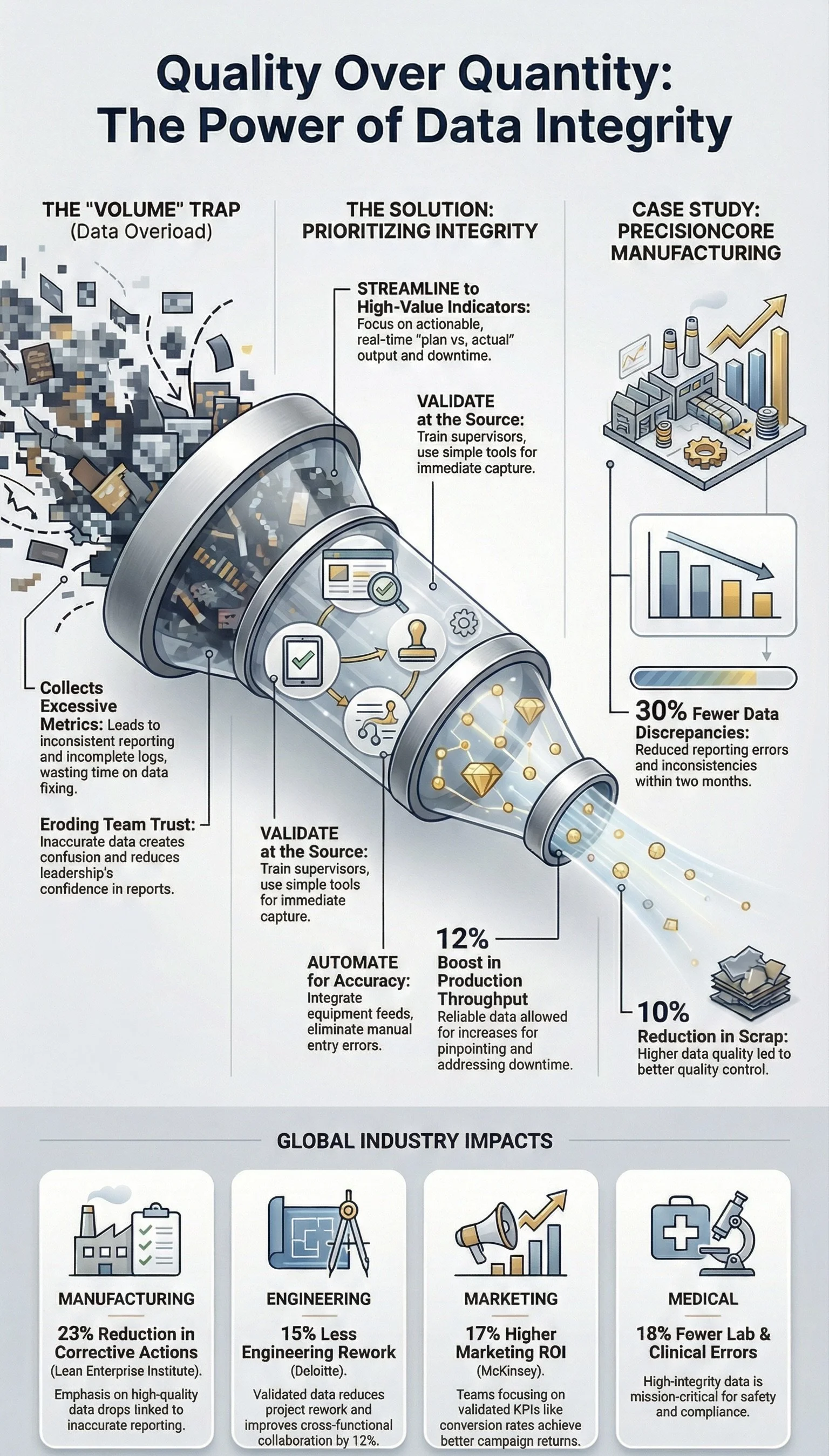
Consider the case of PrecisionCore Manufacturing. Despite tracking dozens of metrics, the facility was paralyzed by inconsistent shift reporting and incomplete downtime logs. This created significant friction; daily huddles devolved into arguments over if a machine was actually down, rather than focused analysis on why it failed. When your data is untrustworthy, your team retreats into a defensive posture, wasting energy fixing the reporting instead of the operation.
"High-quality information gives your team confidence in decision-making and prevents wasted effort on fixing the wrong issues."
Takeaway 2: The "Lean" Data Payoff (By the Numbers)
Shifting to a "lean data" strategy yields immediate, compounding returns. At PrecisionCore, the transition didn't just provide clarity—it drove a 30% reduction in data discrepancieswithin the first two months. This "leading indicator" proved that the team was finally looking at the truth.
To achieve this, the organization implemented three specific tactical interventions:
1. Validation at the Source: Supervisors were trained to validate data entry in real-time.
2. Frontline Empowerment: Operators were provided with simplified, intuitive tools to capture performance data without administrative burden.
3. Automated Feeds: Manual entry was replaced by automated data feeds from key production equipment to eliminate human error.
The statistical results of this streamlined approach are undeniable:
• 12% improvement in production throughput by focusing on real-time plan vs. actual output.
• 10% reduction in scrap through more reliable root-cause identification.
• 23% reduction in corrective actions, a figure supported by the Lean Enterprise Institute as a direct result of moving from inaccurate reporting to high-quality, real-time data.
Takeaway 3: Accuracy is Universal, Not Just Technical
The requirement for data integrity is a cross-functional imperative, spanning from the factory floor to the laboratory and the boardroom. When data is "clean," rework drops and ROI climbs across every vertical:
• Engineering: According to Deloitte, teams prioritizing validated data see a 15% reduction in project rework and a 12% improvement in cross-functional collaboration.
• Marketing: McKinsey research indicates that teams focusing on validated KPIs—such as conversion rates and customer acquisition costs—achieve a 17% improvement in campaign ROI.
• Scientific & Medical: In high-stakes clinical and lab settings, a focus on high-integrity data reduces trial or laboratory errors by as much as 18%.
Takeaway 4: Data Integrity as a Cultural Catalyst
Data integrity is more than a technical achievement; it is the foundation of a healthy Management Operating System (MOS). An MOS—the structured framework of meetings, reports, and behaviors used to manage performance—only functions when there is trust.
At PrecisionCore, the shift toward accuracy transformed the culture. Previously, operators felt their input vanished into a "black hole" of unused metrics. By streamlining to actionable data, frontline workers saw their input drive real-time changes on the floor. This shifted the organizational psychology from a defensive "protect the numbers" mindset to one of proactive problem-solving. Trust in the integrity of the MOS is ultimately more valuable than the complexity of the system itself.
Conclusion: Shifting from "More" to "Better"
The future of leadership belongs to those who can build a leaner data ecosystem. This shift is deeply aligned with Lean and Six Sigma philosophies, where the goal is to eliminate the "waste" of non-actionable information to reduce variability and drive continuous improvement. By prioritizing accuracy and timeliness over sheer volume, you equip your team to make faster, more confident decisions that lead to sustainable success.
Final Thought: Audit your own dashboards before your next meeting. Are you looking at numbers that actually drive your mission forward, or are you just looking at numbers because they exist?