
Mastering the Art of Stepping Up: Why Your Business Needs a Formal Escalation Strategy
1. Introduction: The Cost of Silence
In the high-pressure environments of modern industry, "firefighting" is frequently misdiagnosed as productivity. It is a pervasive workplace frustration: a minor mechanical hiccup or a slight quality deviation occurs, but frontline workers—uncertain of the threshold for intervention—attempt to resolve the issue in isolation. By the time the problem surfaces to management, it has snowballed into a catastrophic production stoppage.
The remedy for this cycle of reactive crisis management is the Escalation Trigger. Defining these triggers is not a move toward micromanagement or an erosion of frontline autonomy; rather, it is a foundational pillar of operational efficiency. By establishing clear protocols, leadership provides the necessary support structure that ensures problems are addressed at the correct management tier without the "silent struggle" that costs organizations millions in lost time.
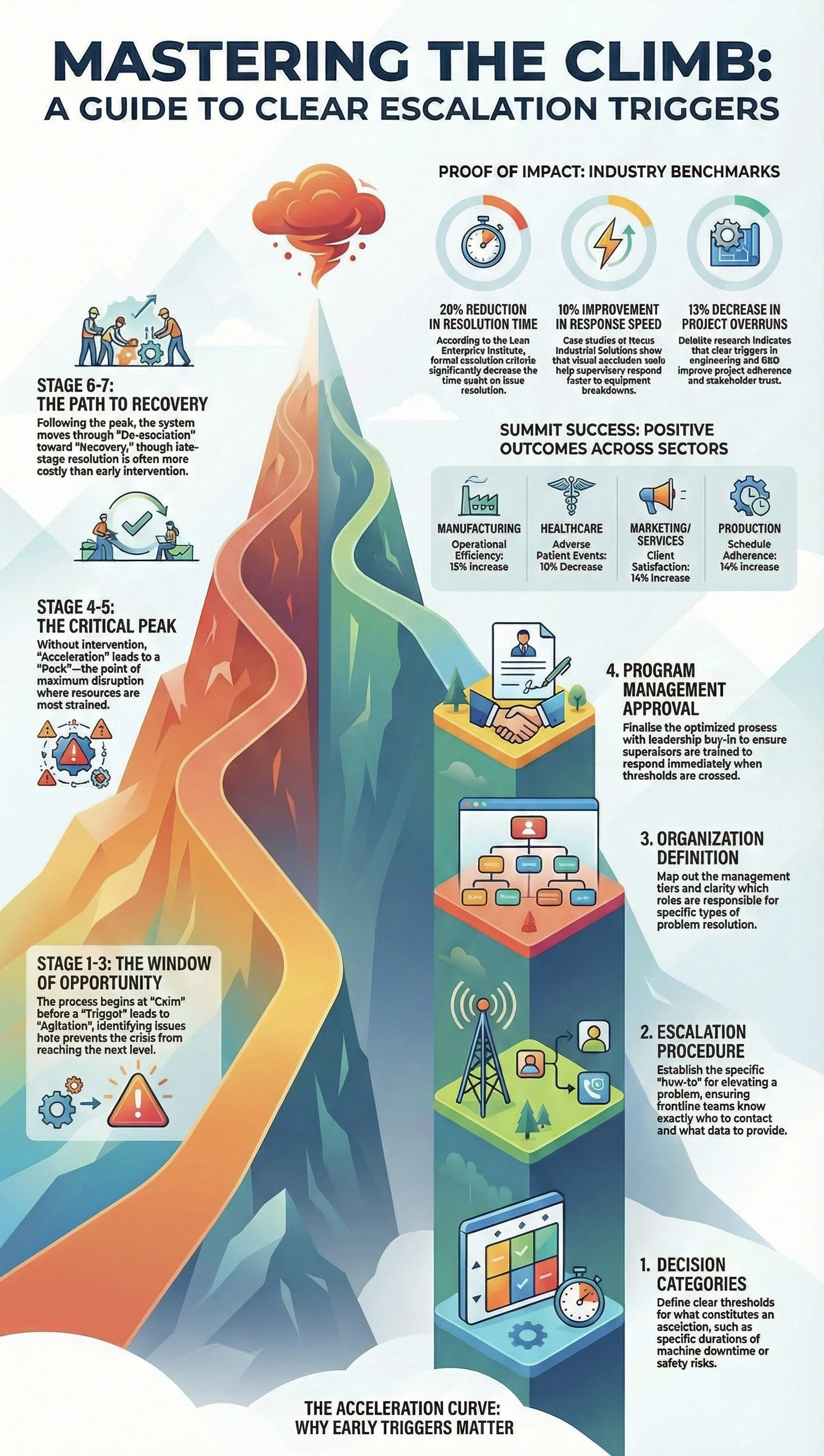
2. Takeaway 1: Understanding the Anatomy of a Crisis (The 7 Stages)
To manage operational disturbances, one must first recognize that every crisis follows a predictable trajectory. As mapped in the "Acceleration" framework, an issue evolves through seven distinct phases:
Stage 1: Calm – Operations are within standard parameters.
Stage 2: Trigger – A specific event deviates from the norm.
Stage 3: Agitation – The issue persists, creating friction.
Stage 4: Acceleration – The problem begins to gather momentum.
Stage 5: Peak – The crisis hits maximum intensity, often a total stoppage.
Stage 6: De-escalation – Active intervention begins to stabilize the situation.
Stage 7: Recovery – The return to the "Calm" state.
From a strategic perspective, the transition between Stage 3 (Agitation) and Stage 4 (Acceleration) is the most critical juncture. As the curve steepens toward the "Peak," the cost of intervention spikes exponentially. Organizations that catch an issue at the Trigger or Agitation phase operate in the "profit zone," resolving problems before they require the massive resource reallocation and downtime associated with a Stage 5 event.
3. Takeaway 2: The 4-Step Blueprint for Optimization
A robust escalation strategy is never a standalone tactic; it is an essential component of a broader Management Operating System (MOS). To move from a reactive culture to a disciplined one, organizations must follow a structured four-pillar blueprint:
Decision Categories: Define exactly which issues require escalation—be it safety, quality, or downtime.
Escalation Procedure: Establish the specific communication channels and timelines used when a trigger is hit.
Organization Definition: Clearly identify the stakeholders responsible at each level. Crucially, Step 1 (Categories) must inform Step 3; you cannot define who is responsible until you have categorized the problem (e.g., a safety breach requires a different chain of command than a supply delay).
Program Management Gets Approval: This is an active process of securing leadership buy-in. Without explicit backing from the top, escalation protocols lack the authority to be enforced.
The final output of these pillars is an Optimized Escalation Process that removes the paralyzing guesswork often found on the factory floor.
4. Takeaway 3: The "18% Rule"—Tangible ROI from the Factory Floor
The theoretical framework of the 4-step blueprint finds its most aggressive validation on the factory floors of Nexus Industrial Solutions. This manufacturer of industrial pumps and valves faced chronic bottlenecks because frontline teams were attempting to troubleshoot complex breakdowns without a clear path for help.
By implementing structured triggers as part of an enhanced MOS, Nexus established what we now call the "18% Rule"—a benchmark for the ROI achievable through protocol clarity. Within six weeks, Nexus saw:
An 18% reduction in average downtime response time.
A 14% improvement in production schedule adherence.
This 18% reduction serves as a rule of thumb for what "good" looks like when implementing these triggers. Beyond the metrics, the shift transformed the corporate culture from one of anxiety to one of empowerment.
"The escalation framework fostered a stronger sense of teamwork and operational ownership. Frontline employees felt supported, knowing they had clear guidelines and leadership backing when issues exceeded their control."
5. Takeaway 4: It’s Not Just Manufacturing—The Universal Power of the Trigger
While the factory floor is the classic proving ground, the need for escalation triggers is universal. Across every high-stakes sector, ambiguity is the primary enemy of performance. Data confirms that removing this ambiguity drives significant results:
Manufacturing/Logistics: Organizations defining formal criteria see a 20% reduction in resolution times and a 15% improvement in overall operational efficiency (Lean Enterprise Institute).
Engineering: Defining triggers for missed milestones or quality deviations reduces project overruns by 13% (Deloitte).
Healthcare: Structured frameworks for clinical incidents have been shown to reduce adverse events by up to 18%.
Services/Marketing: Implementing thresholds for client expectations or schedule delays results in a 14% improvement in client satisfaction (McKinsey).
Whether managing a project in a marketing agency or a clinical trial in a lab, the logic remains the same: clarity creates a culture of timely intervention and accountability.
Conclusion: Moving from Reactive to Proactive
Formalizing an escalation strategy is more than a process improvement; it is a financial imperative. Silence is an "operational tax" that every unguided organization pays in the form of delays, defects, and burnout. Transitioning from a reactive to a proactive stance ensures that your workforce is disciplined, aligned, and—most importantly—supported.
As you evaluate your own operations, ask yourself a difficult question: If a line stops today, does your operator have a protocol, or just a prayer?