
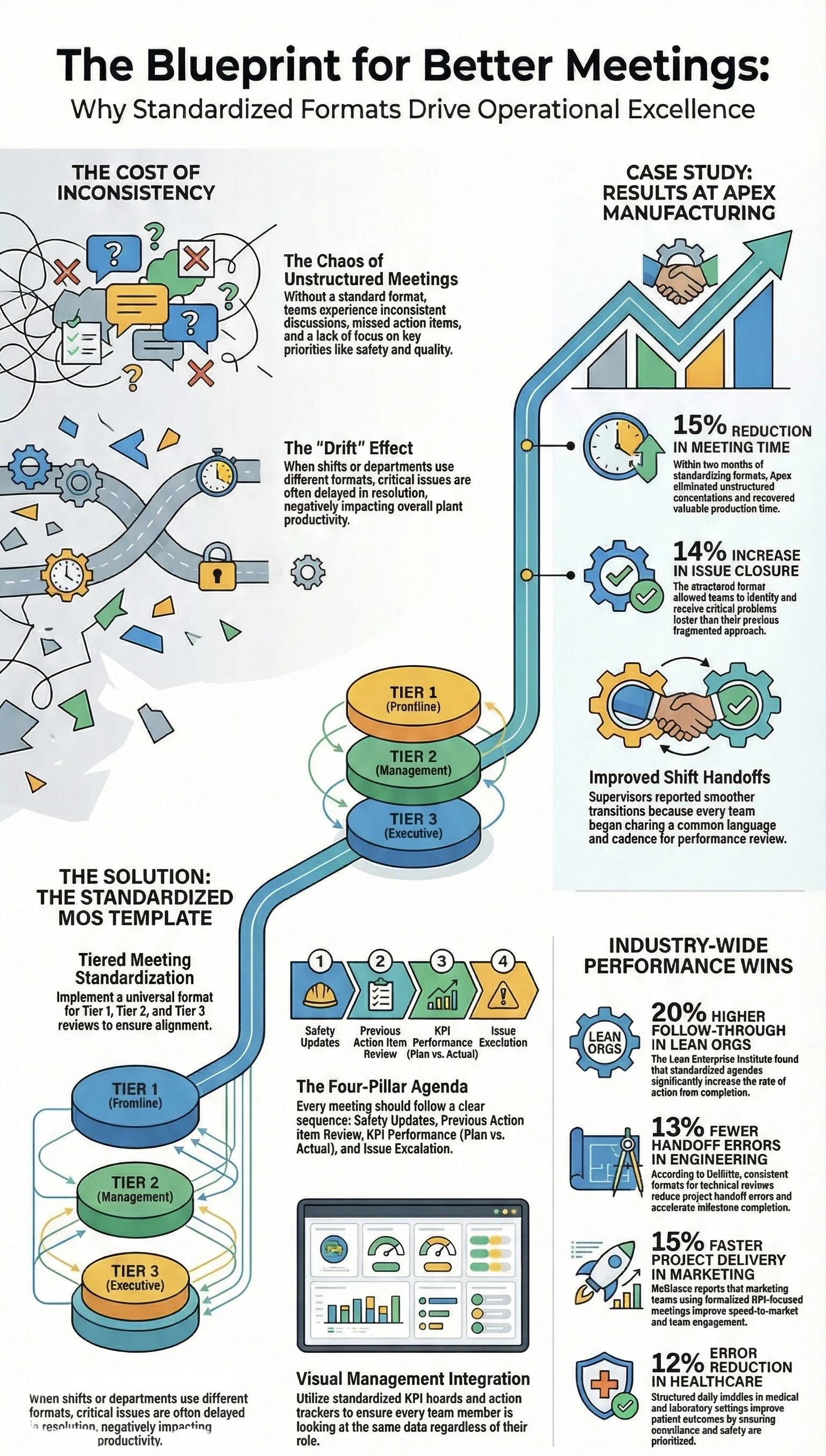
Why the Best Meetings are the Most Predictable: The Surprising Power of Standardized Formats
Most professionals view the "unstructured" meeting as a necessary evil—a wandering, aimless calendar void that drains energy and stalls momentum. We’ve been conditioned to think that rigid agendas stifle creativity, yet the opposite is true. In the high-stakes theater of global operations, predictability is the silent engine of agility. To transform chaos into a competitive advantage, leading organizations are turning to a Management Operating System (MOS) built on a backbone of "Tiered" meetings: Tier 1 (frontline huddles), Tier 2 (middle management coordination), and Tier 3 (executive reviews). By standardizing these touchpoints, leadership moves beyond mere discussion and into a rhythm of relentless execution.
Structure is the Ultimate Time-Saver
The impulse to "wing it" in a meeting is a productivity killer. When a team lacks a predetermined roadmap, they waste the first ten minutes just finding their bearings. By contrast, a standardized template—rigorously focusing on safety, quality, KPI reviews, and issue escalation—acts as a cognitive shortcut. It removes the "how" from the equation so the team can focus entirely on the "what."
Data from the Lean Enterprise Institute and the Apex Manufacturing Group illustrate the sheer math of this efficiency:
• 16% reduction in meeting duration by implementing standardized agendas.
• 15% decrease in total meeting time within just two months of adoption at Apex.
• 20% increase in action item follow-through, ensuring that talk translates to a paper trail of progress.
• 14% increase in issue closure rates.
There is a profound, counter-intuitive freedom in this rigidity. By offloading the structural logistics to a template, teams reduce their collective cognitive load, freeing up mental bandwidth for complex problem-solving. As the operational gospel suggests:
"Consistency is key. Each MOS meeting—whether Tier 1, Tier 2, or Tier 3—should follow a standard format. This helps reduce wasted time and ensures critical elements like safety, quality, and production performance are always addressed."
The Universal Language of Execution
While these "Lean" frameworks were forged on the factory floor, they have evolved into a universal language for the modern knowledge economy. Whether in a creative agency or a university department, a repeatable cadence allows teams to stop debating the process and start hitting milestones. McKinsey and Deloitte findings reveal that this discipline scales across every imaginable sector:
• Marketing and Service Industries: These teams achieved a 15% improvement in project delivery speed and saw a marked rise in team engagement by anchoring meetings in client feedback and KPIs.
• Education: Standardized frameworks for faculty discussions have been shown to drastically reduce miscommunication and bridge the gap between academic strategy and departmental follow-through.
• Supply Chain and Warehousing: In environments where priorities shift by the hour, a repeatable structure ensures that critical logistical bottlenecks are caught before they cascade into the next shift.
A Psychological Shield for High-Stakes Operations
In fields where the margin for error is zero—engineering, science, and medicine—standardization is more than an efficiency play; it is a "Psychological Shield." By mandating that safety and compliance be the first items on every agenda, organizations ensure these critical checks are never "skipped" during high-pressure sprints. At Apex, this was physically manifested through visual management tools like KPI boards, which kept the truth front and center.
The data confirms that this structural discipline saves lives and budgets:
• Engineering: By using consistent formats for project reviews, teams reduced project handoff errors by 13%. This precision directly accelerated milestone completion by 11%, proving that clear communication at the handoff point is the primary driver of project speed.
• Healthcare: In hospital and lab environments, structured tiered meetings led to a 12% reduction in operational errors, directly improving patient outcomes and staff safety.
Standardization as a Cultural Engine for Accountability
Beyond the spreadsheets, there is a human element to predictability. Uncertainty breeds anxiety; when an employee doesn't know how their work will be judged or what a meeting will entail, they enter the room in a defensive crouch. A standardized MOS format replaces that anxiety with a sense of agency.
At Apex Manufacturing Group, the shift to a common language transformed the "shift-to-shift" handoff from a source of friction into a seamless relay. Operators became active participants rather than passive observers because they knew exactly what data was required of them. This environment creates a culture of "no-surprises" accountability. When every level of the organization—from the shop floor to the C-suite—is looking at the same metrics in the same format, the focus shifts from "who is at fault" to "how do we fix the system."
From Discussion to Execution
Meeting standardization is not a bureaucratic hurdle; it is a foundational Lean best practice that serves as the heartbeat of a high-performing culture. By slashing variability in how we communicate, we create a stable platform for the things that actually matter: safety, quality, and results. Predictability, it turns out, is the fastest route to innovation.
If your next meeting followed a strict, five-point template, would you finally have the time to solve the problems you’ve been ignoring?