
The Victory Trap: Why Knowing When to Stop Is the Ultimate Leadership Hack
1. Introduction: The Seduced Leader
For most executives, the "Glory of the Charge" is an intoxicating siren song. We are conditioned to believe that relentless momentum is the only hallmark of a high-performer and that every milestone reached is merely a green light to push harder. However, in the high-stakes arena of organizational transformation, the most dangerous moment for a leader is the one immediately following a hard-won victory.
This is the Victory Trap: an ego-driven obsession with "more" that blinds leaders to the reality that they have outrun their own supply lines. When success leads to immediate overreach, the result is rarely growth; it is the accumulation of cultural and technical debt that eventually bankrupts the original win. To navigate this, the modern architect of culture must master the Strategic Pause. By internalizing the framework to Stop. Think. Lead., leaders transform from impulsive chasers of momentum into disciplined guardians of sustainable performance.
2. Takeaway 1: Law 47—The Counter-Intuitive Power of "Enough"
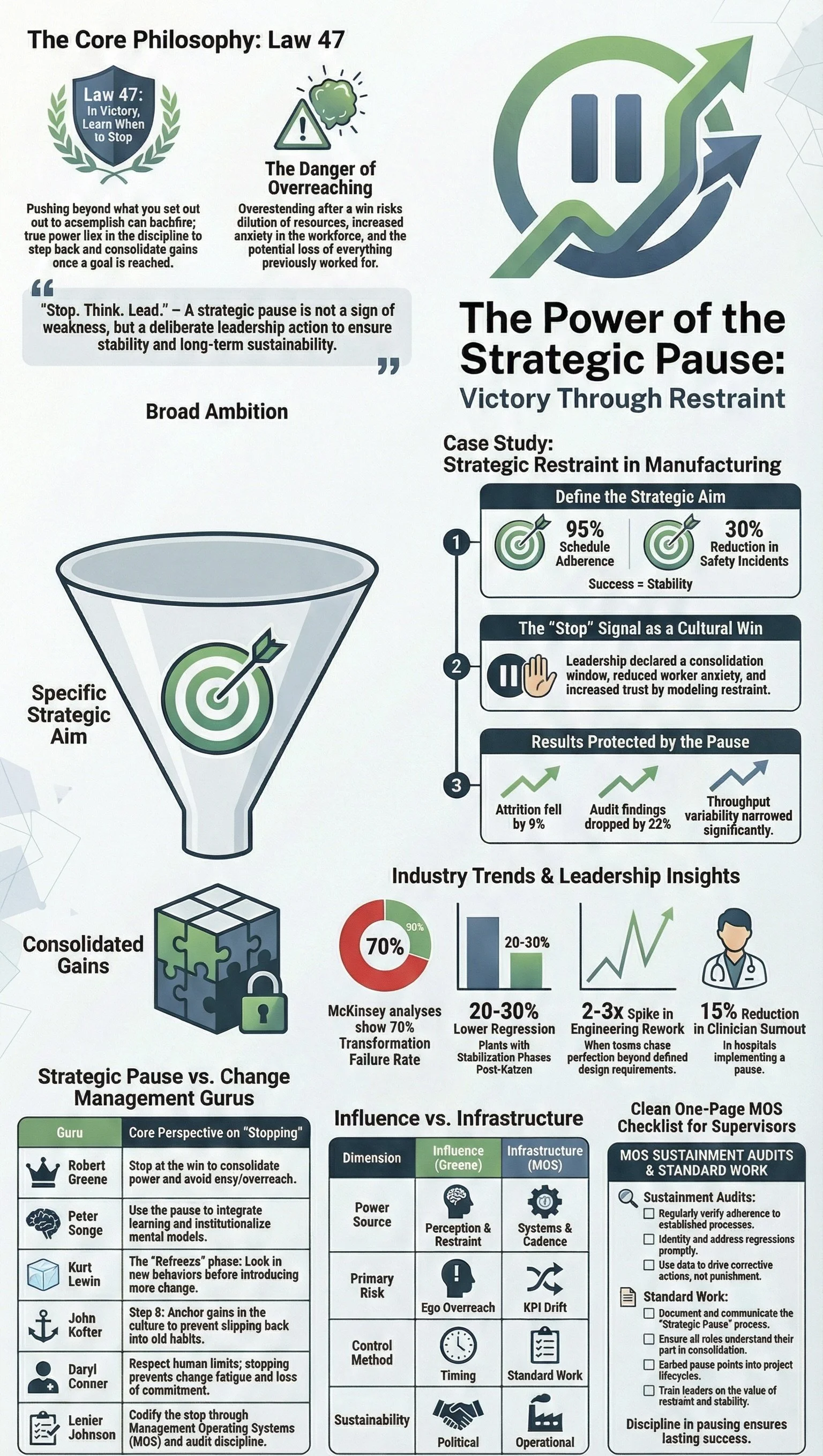
The psychological foundation of strategic restraint is best captured in Robert Greene’s 48 Laws of Power. Law 47 explicitly warns: "Do Not Go Past the Mark You Aimed For; In Victory, Learn When to Stop."
Greene’s central argument is that the arrogance born of success creates a vulnerability. Pushing beyond an original objective often invites unnecessary risks and triggers a counter-reaction from a system—or a market—that was not prepared for the expansion.
"There’s power in knowing when to stop. Pushing beyond what you set out to accomplish can backfire and lead to unnecessary risks or losses. After achieving your goal, step back and consolidate your gains. Overreaching can lead to the loss of everything you’ve worked for."
For leaders, the "Victory Trap" is difficult to avoid because it feels like confidence. In reality, failing to stop at the intended mark is a failure of discipline. True power is found in the ability to reach a peak, plant the flag, and consolidate the position before attempting the next ascent.
3. Takeaway 2: The "Invisible" Costs of Overreaching (By the Numbers)
Restraint is not a philosophical luxury; it is an operational necessity. When organizations fail to pause, they incur "invisible costs" that degrade the very value they sought to create. Expansion without stabilization creates a fragility that eventually leads to systemic regression.
• Economics: McKinsey analyses reveal that 70% of transformations fail when scope expands too aggressively immediately following early success.
• Engineering: Chasing "perfection" beyond defined requirements causes engineering change orders to spike 2–3x, creating massive rework loops.
• Medical: Hospitals that institute a deliberate pause after protocol wins see a 10–15% reduction in clinician burnout, proving that sustainment protects the practitioners.
• Marketing: Campaigns that over-reach target frequency see a 5–8% increase in churn, as brand fatigue outweighs brand awareness.
• Warehousing: Rushing additional automation or scope before stabilizing current wins increases error rates by up to 12%.
These statistics highlight a critical truth: growth without a "refreeze" phase creates a deficit of capability. Restraint is the only way to avoid the "technical debt" of a rushed victory.
4. Takeaway 3: Trust is Built in the "Pause" (Lessons from Manufacturing)
The cultural power of restraint is best illustrated by a mid-size manufacturing enterprise that underwent a 24-month Management Operating System (MOS) transformation. Their targets were specific: 95% schedule adherence and a 30% reduction in safety incidents.
By month 14, the organization saw an 11-point improvement in OEE (Overall Equipment Effectiveness). While the board pressured for immediate further automation, the leadership team chose the Strategic Pause. They declared a consolidation window, explicitly stating: “We stop at the mark we aimed for—then protect it.”
This "Strategic Restraint" served as a powerful Cultural Signal. By resisting the ego-driven urge for "more," leadership demonstrated that they valued the sanity and safety of the frontline over the novelty of new projects. When leaders say "no" to the next shiny initiative, they are saying "yes" to the psychological safety of their workers. This discipline allowed the organization to lock in "Standard Work," resulting in a 9% drop in attrition and a 22% reduction in audit findings.
5. Takeaway 4: The Guru Consensus—Why Every Change Expert Agrees on "Refreezing"
While the terminology varies across schools of thought, there is a clear consensus among change management experts: victory requires stabilization. The following table highlights how different models view the "Stop" signal, with Lenier Johnson’s MOS serving as the practical bridge that turns these theories into daily reality.
Change Expert
Perspective on the "Stop" Signal
Kurt Lewin
Emphasizes the "Refreeze" stage; behaviors must be locked in before new variables are introduced.
John Kotter
Warns against declaring victory too soon; gains must be anchored in the culture to prevent a return to old habits.
Daryl Conner
Focuses on human energy limits; the pause is essential to prevent "change fatigue" and the loss of team commitment.
Lenier Johnson
Provides the practical tool: Use the Management Operating System (MOS)to codify the "stop" through tiered meetings and audits.
6. Takeaway 5: Infrastructure vs. Influence—The MOS Perspective
There is a sharp distinction between the psychological timing of the "Stop" and the systems required to sustain it. Robert Greene’s Law 47 focuses on Influence and Perception—the psychology of knowing when your timing is right. However, a Management Operating System (MOS) focuses on Infrastructure and Systems.
If Law 47 is the wisdom to know when to stop, the MOS is the scaffold that holds the victory in place. Without the structural integrity of a system, even the most well-timed pause will eventually give way to "KPI drift." A sustainable victory is built on three MOS pillars:
• Tiered Meetings: Ensuring the win is discussed, defended, and maintained daily.
• Visual KPIs: Providing clear, non-negotiable thresholds that signal when a goal is reached.
• Standard Work: Documenting the new "status quo" to ensure the organization cannot regress to its previous state.
7. Conclusion: Victory Is Sustainment, Not Just Expansion
True leadership power is not found in endless motion; it is found in restraint with intent. A mature organization understands that reaching the mark is only the first half of the mission. The second, and more difficult half, is the discipline required to stay there.
Expansion is a test of ambition, but sustainment is a test of character. As you evaluate your current portfolio of projects and initiatives, look past the allure of the next milestone and ask yourself: Have you reached your mark, or are you currently risking your victory by refusing to stop?