
Why Being a 'Perfect' Leader is Killing Your Team’s Productivity
1. Introduction: The High Cost of Flawless Leadership
In high-stakes industrial and corporate environments, there is a lingering belief that a leader must be a beacon of unshakable execution. However, this "pedestal" approach to leadership creates a dangerous paradox that stalls organizational growth. When a leader appears to have no flaws, they unintentionally foster a culture of silence, envy, and hidden mistakes.
The pressure to mirror a "perfect" leader forces teams into "performance theater" where maintaining an image of competence is prioritized over solving problems. This dynamic sits at the heart of Robert Greene’s Law 46: "Never Appear Too Perfect." When leaders project an image of unattainable excellence, they don’t inspire their workforce—they alienate them, creating a barrier of resentment that prevents honest communication.
2. Takeaway 1: Perfection Breeds Silence, Not Excellence
Visible perfection is frequently a liability because it triggers deep-seated jealousy and resentment among subordinates. In manufacturing and engineering, a leader who never admits a mistake sets an impossible standard that employees feel they must also simulate. This lead to a "frozen" culture where data is massaged on KPI boards and critical issues are suppressed until they inevitably explode.
According to the principles of Law 46, a flawless facade creates an emotional distance that stifles genuine engagement. People are instinctively wary of those who seem too clinical or beyond reproach, viewing them as untrustworthy or politically dangerous.
"Perfection is often seen as unattainable... People are drawn to those who seem human, not to those who appear flawless."
By showing vulnerability, leaders break the cycle of performance theater. Admitting a mistake moves the team’s energy away from defensive posturing and toward actual operational productivity.
3. Takeaway 2: The '38% Effect' – How Vulnerability Drives Safety
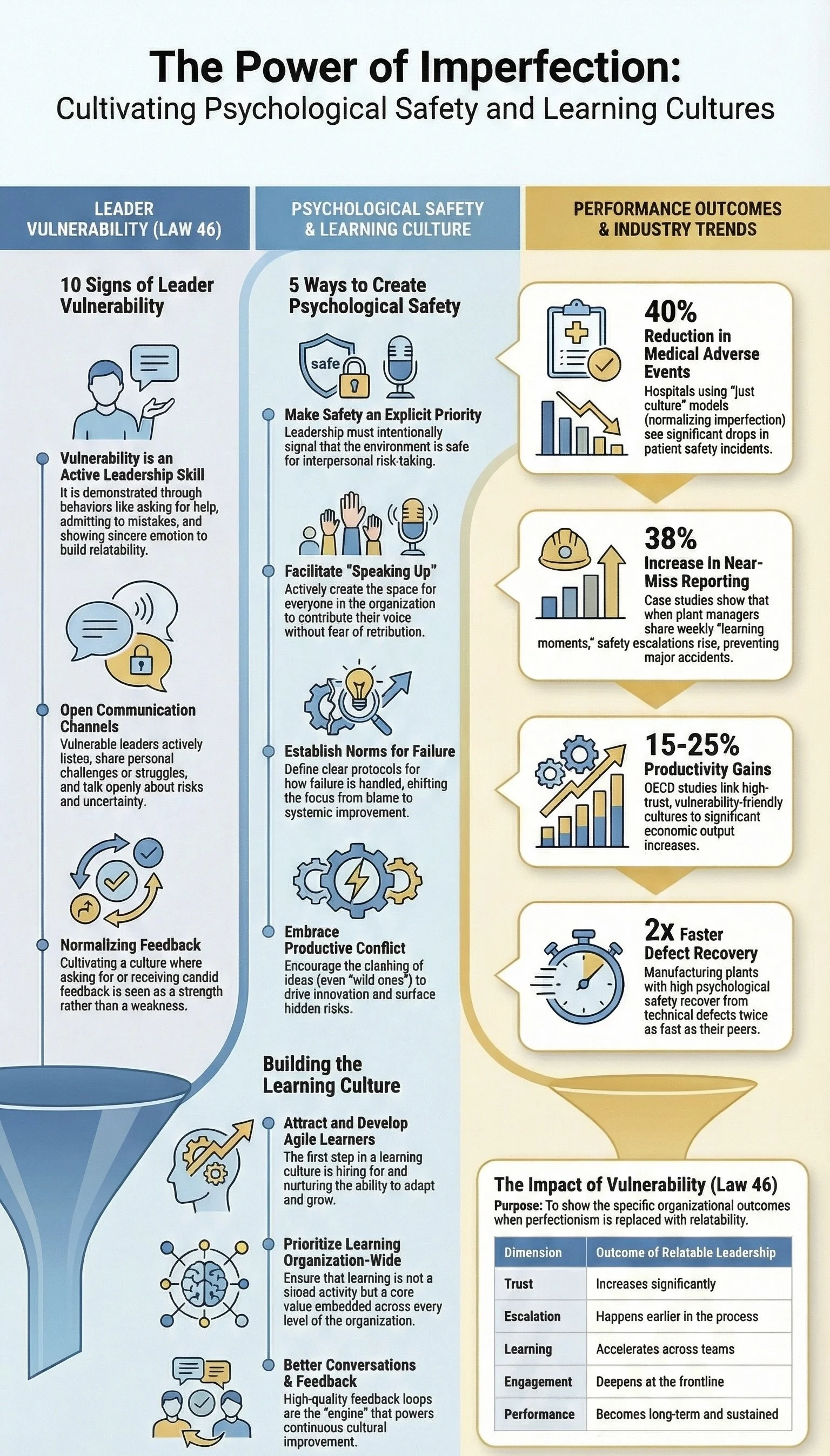
The impact of modeling imperfection is empirically measurable within the Management Operating System (MOS). In a recent case study of a manufacturing plant, leaders transitioned from "technical experts" to "human leaders" by publicly sharing weekly "learning moments" during Tier-3 reviews. Instead of punishing "red" metrics on KPI boards, they used them as starting points for collaborative inquiry during shift huddles.
The results of this leadership reset demonstrate that vulnerability is a catalyst for high performance:
• Safety Reporting: Near-miss reporting increased by 38%, signaling that the frontline finally felt safe to escalate risks.
• Trust and Engagement: Organizational trust scores rose by 21% as the perceived distance between management and operators closed.
• Retention: Regrettable attrition declined as the culture shifted from one of judgment to one of collective learning.
• Operational Speed: Continuous improvement events accelerated because Short Interval Control (SIC) became a tool for learning rather than a mechanism for blame.
4. Takeaway 3: Vulnerability is a Visible Practice, Not a Feeling
Vulnerability in leadership is not an abstract emotional state; it is a systematic practice that must be integrated into the organization's infrastructure. To transition from an image of perfection to one of relatable authority, leaders must exhibit the "Signs of Vulnerability." This includes behaviors such as asking for help, listening deeply, admitting to mistakes, and asking for or receiving candid feedback.
To be effective, these behaviors must be reinforced by more than just personality. While Robert Greene focuses on the social influence gained through relatability, modern strategists like Lenier Johnson argue that vulnerability must be built into the MOS. It must move from a personal trait (Greene) to a structural infrastructure (Johnson).
Dimension
Greene’s Influence
Johnson’s MOS Infrastructure
Power Base
Perception of Relatability
Cadence of Tier Meetings
Safety Type
Emotional Connection
Structural Escalation Rules
Learning
Social Permission
Embedded KPI Reviews
Risk
Personal
Systemic
Scale
Individual
Enterprise
Application
Individual Behavior
Standard Work & SIC
5. Takeaway 4: Psychological Safety Requires Embracing Productive Conflict
Cultivating a high-performance Learning Culture is impossible without psychological safety. This requires a leader to "unfreeze" the organization’s current state—a process Kurt Lewin identified as essential for change. By admitting their own limits, leaders build the urgency and coalition-building power described by John Kotter, signaling that the "old way" of hiding mistakes is over.
To systematically build this culture, leaders must focus on four specific components:
• Attracting and developing agile learners.
• Creating a psychologically safe environment.
• Encouraging better conversations and feedback loops.
• Prioritizing learning throughout the entire organization.
Furthermore, creating psychological safety requires five specific actions: making it an explicit priority, facilitating everyone speaking up, establishing norms for how failure is handled, creating space for new ideas, and—crucially—embracing productive conflict. This moves the organization away from a state of "polite silence" and toward a state of continuous adaptation.
6. Takeaway 5: Trust-Based Cultures are a Global Economic Advantage
The shift toward transparent, "imperfect" leadership is a competitive necessity across every major global sector. Trust-based cultures outperform their "perfect" competitors by surfacing the truth faster and more reliably.
Manufacturing & Supply Chain Plants prioritizing psychological safety report a 2x faster recovery rate from defects. In broader supply chains, transparent leadership improves cross-node coordination and resilience.
Economics & Government OECD research links trust-based cultures to productivity gains of 15% to 25%. In the Federal Government, agencies practicing after-action reviews show significantly higher mission resilience.
Medical & Science Hospitals using "just culture" models reduce adverse events by 40% by normalizing the reporting of mistakes. Similarly, science teams with imperfect leaders publish more reproducible and accurate results.
Education & Marketing Schools focusing on teacher learning outperform test-driven systems. In Marketing, authentic brands that admit mistakes outperform "polished" competitors in long-term consumer loyalty metrics.
Conclusion: From Performance Theater to a Learning Organization
The most effective leaders understand that true power is not found in a flawless facade—it is found in the ability to surface the truth early. Moving from "appearing perfect" to "providing permission" is the fundamental shift required to build a sustainable, high-performance organization. As Law 46 reminds us, being human is a leadership strategy, not a weakness.
What was the last mistake you publicly acknowledged to your team?