
The Complexity Trap: Why Your Management Tools Are Killing Productivity
In boardrooms and factory floors alike, there is a seductive myth that has become the "silent killer" of productivity: the belief that more data equals more control. We see it every Monday morning—leaders walking into huddles armed with multi-page spreadsheets, granular dashboards, and complex trackers, believing that this "thoroughness" is the key to excellence.
In reality, this is often a defensive management tactic—a psychological "illusion of control" that backfires the moment it hits the frontline. When the tools designed to drive performance become so dense that they require a manual to navigate, they cease to be steering mechanisms. They become anchors. We have reached a tipping point where the weight of "administrative bloat" is suffocating the very operations it was meant to optimize.
The central question every leader must ask is this: Are your management tools designed to capture data, or are they designed to empower the people who use them?
The Engagement Tax: Why Complexity Rejects Culture
Complexity is not a neutral attribute; it is a heavy tax on your organizational culture. When Management Operating Systems (MOS)—the charts, forms, and trackers that dictate daily rhythm—are over-engineered, they trigger an immediate sense of detachment. Frontline workers stop seeing these tools as a path to excellence and start viewing them as "admin work" that interrupts their real job.
To reclaim momentum, the focus must shift from the friction of data entry to the energy of active improvement. As the industry standard dictates:
"Design your MOS tools to be simple, practical, and easy to maintain so that teams can focus on improvement, not admin work."
The "Less is More" Participation Boost
It is a counter-intuitive truth of operational psychology: the more "robust" a system is, the less likely it is to be used accurately. Conversely, when you lower the barrier to entry by stripping away non-essential data points, participation skyrockets. This isn't just a theory; the data across diverse sectors is definitive:
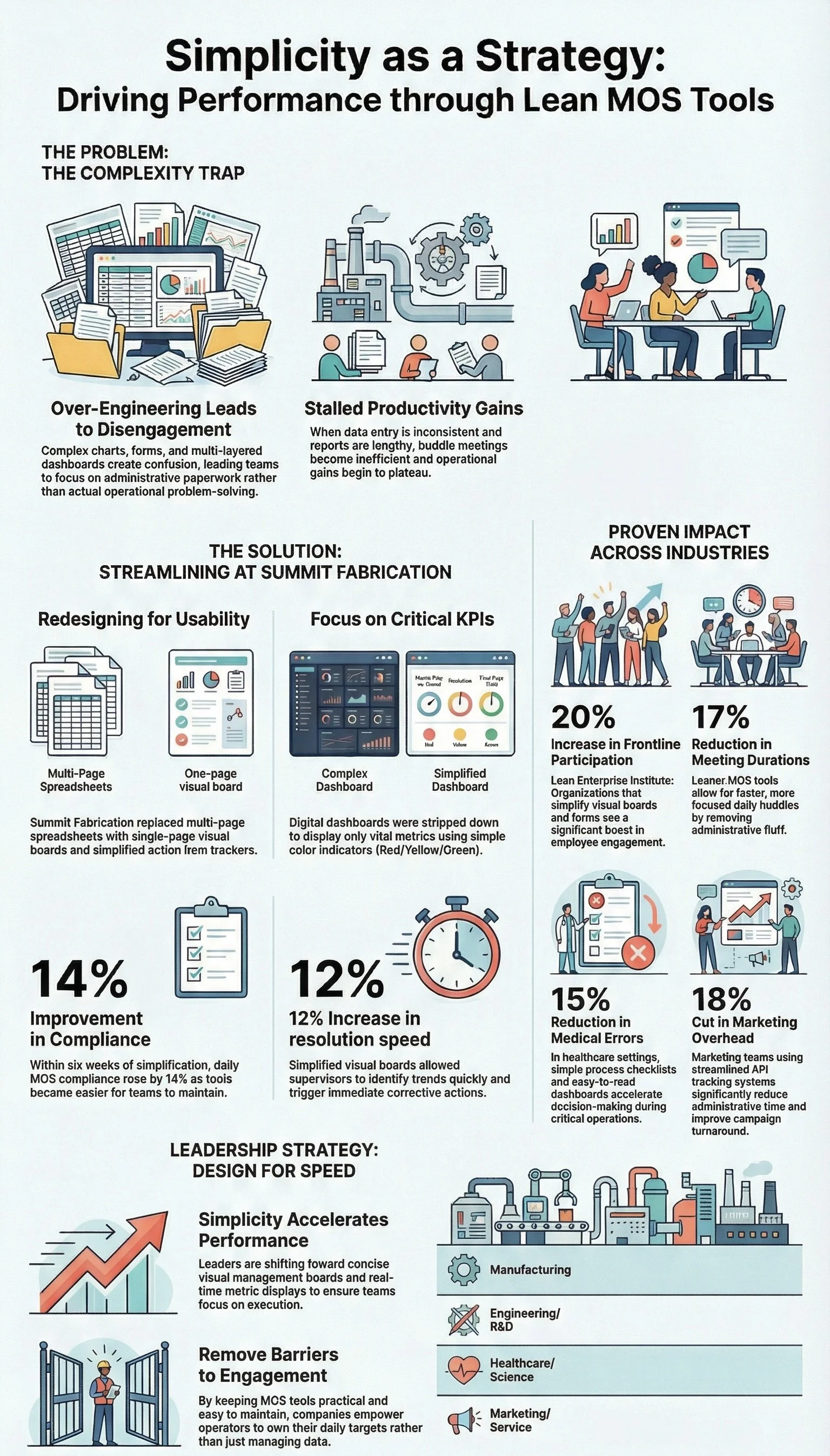
• Frontline Ownership: According to the Lean Enterprise Institute, organizations that simplify their visual boards and forms see a 20% improvement in frontline participation.
• Operational Velocity: Simplification yields a 17% reduction in meeting durations, transforming huddles from status-report marathons into action-oriented sprints.
• The Overhead Mirage: Research from McKinsey reveals that marketing and service-based teams using leaner KPI tracking systems can slash administrative overhead by 18%.
• Customer Impact: In service environments, reducing complexity in case management tools has been shown to drive a 14% increase in customer satisfaction (CSAT) and significantly faster resolution times.
Simplicity as a Safety and Speed Mechanism
The benefits of simplification extend far beyond the balance sheet; in high-stakes environments, clarity is a prerequisite for survival. There is a direct "connective tissue" between participation and reliability: when tools are easy to use, the data gathered is more frequent and accurate, which allows for a proactive safety net.
In technical and scientific sectors, streamlined project tracking is a competitive necessity. A report from Deloitte indicates that engineering and R&D teams that simplify design review templates reduce project cycle times by 12%. In healthcare and laboratory settings, the stakes are even higher. The implementation of simplified visual management tools and clear process checklists is linked to a 15% reduction in errors. In these environments, usability ensures that frontline staff can make split-second decisions without getting lost in the "noise" of overly complex reporting.
Case Study: The Turning Point at Summit Fabrication
The journey of Summit Fabrication, a manufacturer of custom metal assemblies, illustrates the shift from "data hoarding" to "actionable insights."
The Burden: Summit’s original MOS was a masterpiece of over-engineering—multi-page spreadsheets and dashboards intended to capture every conceivable variable. However, during fast-paced shifts, the tools were ignored. Data entry became a "guesswork" exercise performed at the end of the day, huddles were bogged down by irrelevant reports, and productivity stalled.
The Intervention: Leadership made the radical choice to strip the system down. They replaced the binders with a single-page visual management board. They eliminated secondary data points and streamlined digital displays to show only "The Vital Few": hourly plan vs. actual, downtime, and first-pass yield.
The Transformation: The results were immediate and narrative-shifting. Within six weeks, the plant saw a 14% improvement in daily MOS compliance and a 12% increase in the speed of issue resolution. More importantly, a cultural shift occurred. By replacing dense data with simple red/yellow/green indicators, shift handoffs became seamless. Operators moved from being "burdened by tasks" to feeling "empowered to drive performance." The system finally served the people, rather than the other way around.
The Visual Advantage: The Power of "At-a-Glance"
The most effective management tools operate at the speed of sight. Moving toward simple visual indicators—specifically red, yellow, and green status signals—provides near-instantaneous situational awareness.
These visual cues allow a supervisor to identify a bottleneck from across the room, triggering corrective action in real-time rather than at the end of a shift when the damage is already done. This "frictionless" visibility ensures that every team member, regardless of their role, understands the current operational status in seconds, fostering a culture of collective ownership.
Conclusion: The Future of Frictionless Management
The era of the over-engineered, "just-in-case" data template is coming to a close. Across every sector—from the hospital ward and the marketing agency to the factory floor—the industry-wide trend is moving toward "radical usability."
The future of management isn't found in the most complex dashboard; it’s found in the simplest one. Leaders who embrace this shift understand that their primary job is to remove the "administrative noise" that prevents their people from doing their best work.
As you look at your own dashboards and forms today, ask yourself: Are these tools helping your team win the day, or are they just making them record the loss?