
The Tortoise’s Edge: Why Radical Reform is the Enemy of Real Change
1. Introduction: The High Cost of Haste
In the modern executive suite, the fallacy persists that the velocity of a transformation initiative is a direct proxy for its efficacy. This mindset precipitates the launch of multiple, uncoordinated "urgent" programs that inevitably collide, resulting in profound "initiative fatigue." While these shifts are born of a desire for progress, the strategic imperative is to recognize that the fastest route to systemic change is often a calculated deceleration. By adhering to Robert Greene’s Law 45—preaching the need for change while eschewing excessive reform—leaders can navigate the volatile space between stagnation and chaos.
2. Takeaway 1: Change is a Psychological Threat, Not Just a Process
The executive fallacy lies in equating rapid-fire execution with seriousness. However, behavioral science confirms that abrupt organizational shifts trigger an amygdala-based threat response. Employees perceive radical reform not as a strategic evolution, but as an existential threat to their stability. When psychological safety is sacrificed at the altar of speed, the workforce shifts from a state of innovation to one of self-preservation.
Leaders who prioritize speed over behavioral anchoring inadvertently manufacture the very resistance they intend to dismantle. As Robert Greene observes:
"People are resistant to change, so when introducing new ideas, make sure to ease them in gradually. Overwhelming others with drastic reforms creates fear and resistance."
3. Takeaway 2: The Statistics of Overload—Stability Precedes Scale
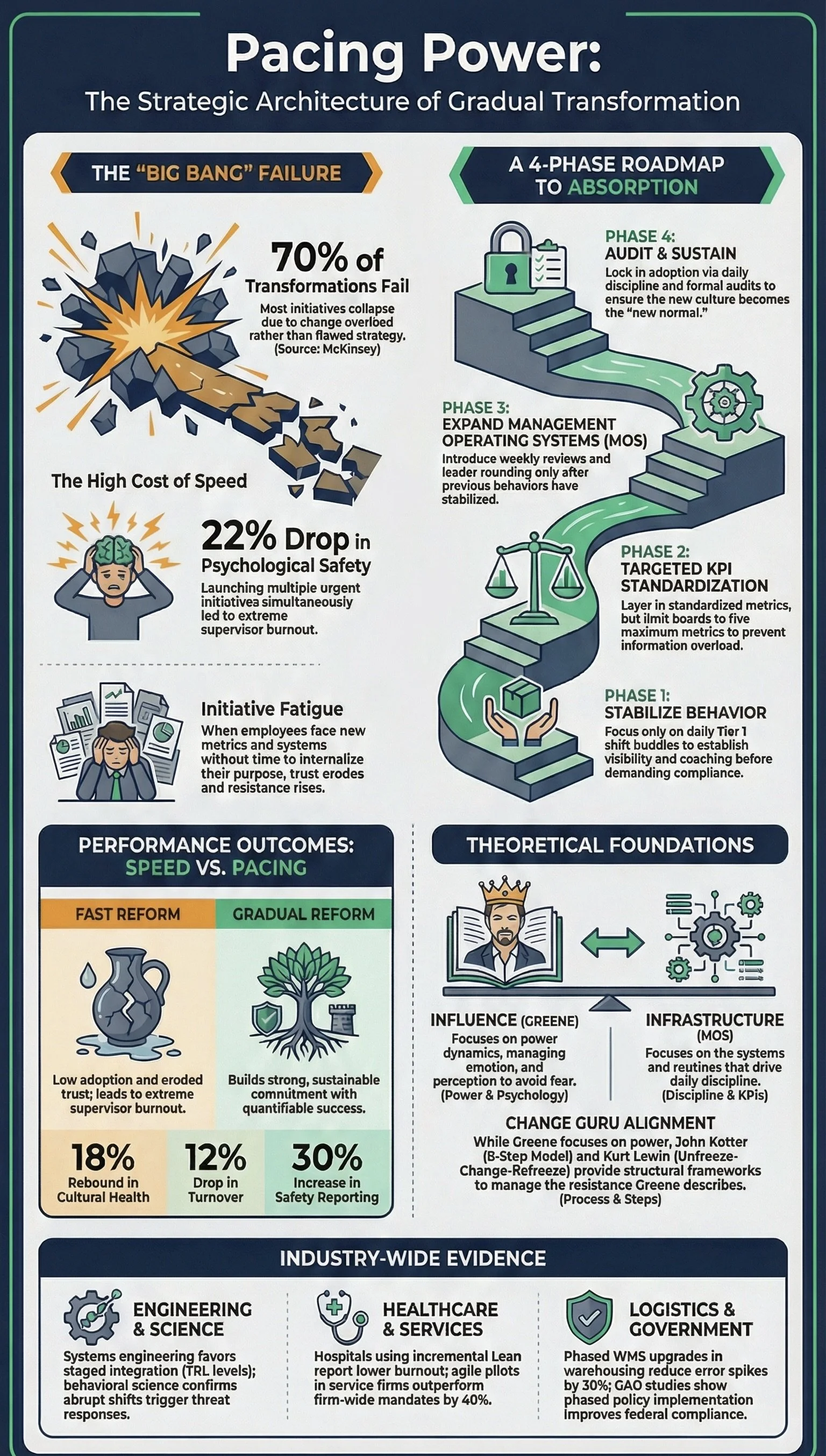
The data regarding transformation initiatives is stark: McKinsey reports a 70% failure rate, largely attributable to change overload rather than strategic flaws. To achieve sustainable ROI, an organization must prioritize volatility reduction through phased implementation.
The cross-industry evidence for gradualism is definitive:
• Manufacturing: Plants utilizing phased rollouts achieve 2× higher Overall Equipment Effectiveness (OEE) gains compared to "big bang" implementations.
• Engineering: Success is dictated by staged integration via Technology Readiness Levels (TRL), ensuring stability precedes scale.
• Warehousing: Zone-phased WMS upgrades reduce error spikes by over 30%.
• Medical: Incremental Lean implementation correlates with lower clinician burnout and superior patient safety scores.
• Education: Districts employing phased standards adoption outperform "full reset" peers by 25%.
• Economics & Government: Incremental policy changes mirror economic shock absorption, reducing labor resistance and improving compliance rates.
4. Takeaway 3: The "Tier 1" Strategy—Behavioral Sequencing in Action
A mid-sized manufacturing organization recently illustrated the power of "layering" reforms. Following a period of uncoordinated shifts that caused a 22% drop in psychological safety, leadership paused to implement a three-phased roadmap centered on behavioral sequencing.
• Phase 1: Stabilization. The initial reform was restricted exclusively to daily Tier 1 shift huddles. No other operational changes were permitted, allowing supervisors to articulate the "why" behind the visibility before demanding compliance.
• Phase 2: Restraint. Leadership exhibited strategic discipline by refusing to add new requirements until huddle attendance stabilized at 95%. This restraint acted as a force multiplier, building trust through consistency.
• Phase 3: Layering. Only after the huddles were institutionalized did the firm introduce KPI standardization, strictly limiting boards to five actionable metrics to prevent cognitive overload.
The results were transformative: cultural health scores rebounded by 18%, voluntary turnover dropped by 12%, and safety near-miss reporting increased by 30%. By pacing the reform, the organization moved from forced compliance to genuine emotional buy-in.
5. Takeaway 4: Power vs. Process—Where Greene Meets the Gurus
To master transformation, a leader must distinguish between Influence (Psychological Power) and Infrastructure (Operational Discipline). While management gurus provide the structural "how," Greene provides the psychological "why."
Aspect
Robert Greene
John Kotter
Management Operating Systems (MOS)
Emphasis
Power & Influence
Process & Change Steps
Daily Discipline
Pace
Strategic
Structured
Daily
Focus
Emotion & Perception
Systems & Rollouts
Routines & KPIs
Power Type
Psychological
Operational
Operational
Primary Risk
Manipulation
Bureaucracy
Bureaucracy
While Kotter’s 8-Step model institutionalizes the pacing of a rollout, Greene’s insights explain the political nuance of why resistance forms. Integrating these perspectives allows a leader to manage the human response (Influence) while locking in behaviors through daily discipline (Infrastructure).
6. Takeaway 5: The Absorption Factor—Transformation vs. Compliance
The ultimate metric of a successful transformation is not the speed of the rollout, but the rate of absorption. Transformation is the process of internalizing change until it becomes the cultural default; compliance is merely the temporary adherence to a mandate under pressure.
When reforms are forced onto an organization, the result is weak sustainability and eroded trust. Conversely, gradual reform allows the organization to "absorb" new behaviors, embedding them into the cultural fabric. True commitment is only achieved when the workforce feels the change is predictable and manageable. In the case study provided, the 30% increase in safety reporting served as a lead indicator that employees had moved beyond fear-based compliance into a state of active commitment.
7. Conclusion: The Strategic Pause
Sustainable progress requires the executive courage to pause. Leaders who pace reform earn the trust of their workforce, allowing them to compound momentum over time rather than dissipating it through constant upheaval. By choosing behavioral sequencing over radical reform, organizations transition from a state of perpetual "novelty" to a state of sustained "performance."
Is your current speed of change driving progress, or is it just driving your best people away?