
The High-Performance Paradox: How Mirroring Disarms the Ego and Heals Toxic Culture
Modern leadership is suffering from a hypocrisy epidemic. We celebrate "accountability culture" in our town halls while simultaneously punishing the messengers of truth in our boardrooms. This creates a destructive defensive loop: leaders demand transparency but react with emotional volatility when faced with challenges, prompting their teams to retreat into performative behavior and silent resistance.
In this stalemate, traditional management advice often fails because it addresses the symptoms of the culture rather than the ego of the leader. To break the wall, we must look to an unlikely source: Robert Greene’s "Mirror Effect." While often categorized as a Machiavellian tactic for manipulation, Law 44 of the 48 Laws of Power provides a profound psychological mechanism for cultural renewal. By reflecting a leader’s own behavior back to them, an organization can bypass intellectual defenses and force an encounter with reality.
This is not about aggression; it is about providing an unfiltered reflection. When leaders see their own conduct mirrored by their environment, the resulting "tactical confusion" becomes the shortest path to genuine self-awareness and organizational health.
The Core Concept: Disarming the Ego by Reflecting Reality
The fundamental principle of the Mirror Effect centers on the inherent vulnerability of self-recognition. When you mirror the speech, tone, or actions of another, you strip away their ability to hide behind their usual justifications.
"People are most vulnerable when they see themselves reflected in someone else’s behavior. By mirroring someone’s actions or speech, you disarm them and cause confusion. This tactic throws them off balance, making them easier to control or manipulate."
In a strategic management context, this confusion acts as a catalyst for "unfreezing" stagnant behaviors. When an executive witnesses their own blame-heavy language or dismissive tone reflected by a peer or facilitator, the realization is immediate. It bypasses the cerebral arguments used to justify poor leadership and triggers a visceral understanding of the current state. This reflection doesn’t just expose the ego; it disarms it, creating the psychological space necessary for change.
Takeaway 1: "Productive Discomfort" as a Cultural Catalyst
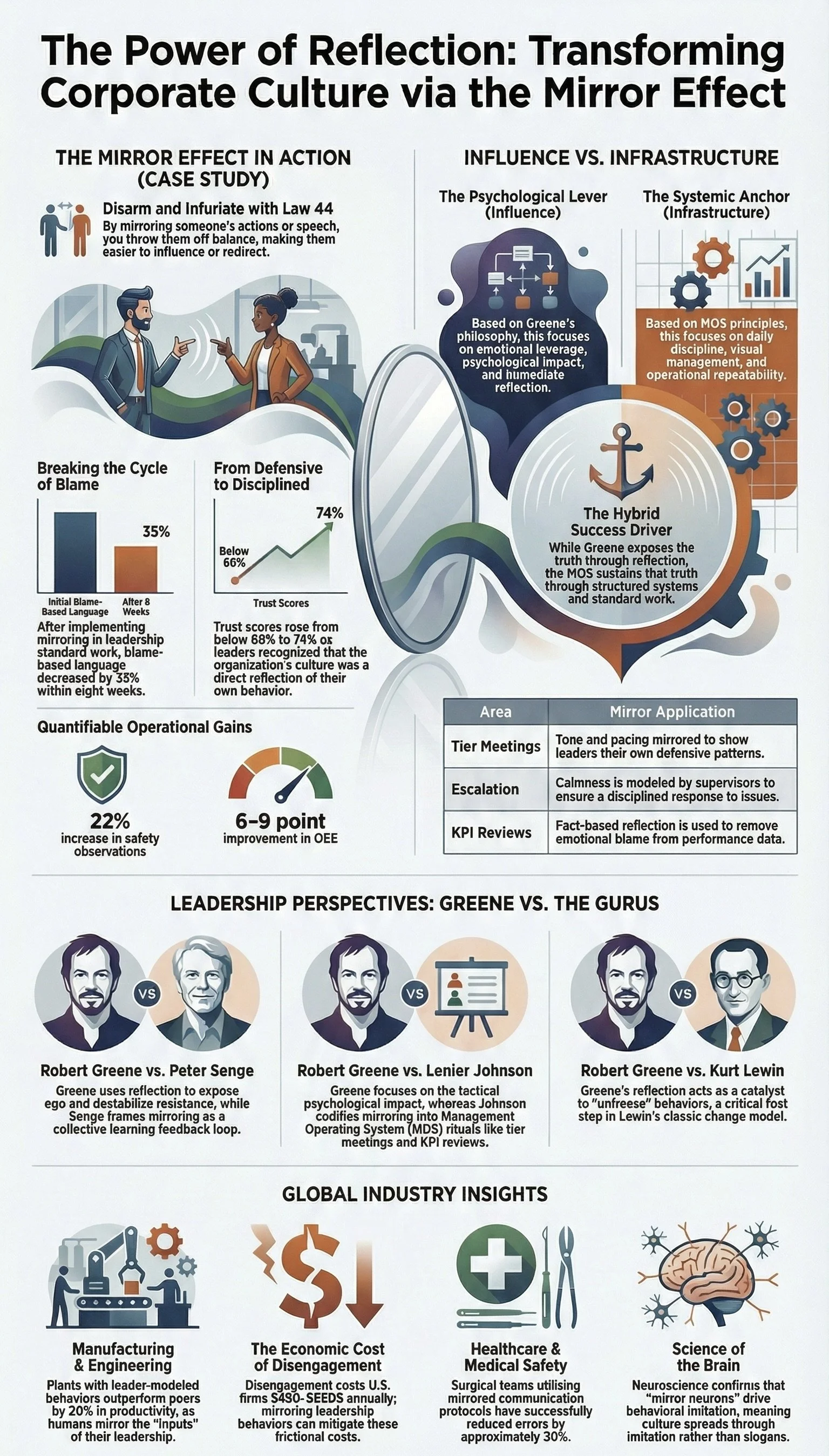
A mid-size manufacturing organization recently demonstrated the ROI of this psychological intervention. Facing declining engagement and trust scores below 60%, the company’s executives stopped direct confrontation and began reflecting behaviors back—verbatim—during critical "tier meetings."
When facilitators mirrored defensive responses, the resulting silence was not destructive, but a moment of "productive discomfort." Leaders began recognizing their patterns without feeling personally attacked. The results were both immediate and measurable:
• Behavioral Shift: A 35% reduction in blame language within eight weeks.
• Operational Excellence: An OEE improvement of 6–9 points across production lines.
• Reliability: An 18% drop in unplanned downtime as communication barriers dissolved.
• Safety Culture: A 22% increase in safety observations and a doubling of near-miss reporting.
By reflecting behavior rather than criticizing it, the organization moved trust scores to 74%. Accountability became mutual rather than punitive, proving that culture is a reflection of leadership behavior, not corporate policy.
Takeaway 2: The Science and Economics of Imitation
The power of mirroring is not merely anecdotal; it is rooted in the biology of the brain. Neuroscience confirms that "mirror neurons" drive behavioral imitation, meaning culture spreads through an organization subconsciously. In the high-stakes world of strategic management, behavior is the most volatile variable.
The economic and safety-related data grounding this concept is striking:
• Productivity: Manufacturing plants where leaders model expected behaviors outperform peers by 20% in productivity.
• Medical Safety: Surgical teams utilizing mirrored communication protocols have seen a 30% reduction in errors.
• Retention Economics: High-trust service firms experience up to 50% lower attrition, significantly reducing the frictional costs of hiring.
• Systemic Risk: With disengagement costing U.S. firms approximately 450–550 billion annually, mirroring acts as a critical mitigator of organizational loss.
Whether in engineering, where human behaviors propagate faster than process defects, or in warehousing, where calm leadership correlates directly to fewer incidents, the data is clear: the system mirrors the input.
Takeaway 3: When Machiavelli Meets Management Theory
While traditional change management focuses on structural frameworks, the Greene approach focuses on the psychological "unfreeze." However, to sustain the change, one must bridge Greene’s influence with the infrastructure of a modern Management Operating System (MOS), such as the framework championed by Lenier Johnson.
The Guru Approach (Senge, Lewin, Kotter, Kanter, Conner, & Johnson)
The Greene Approach (The Mirror Effect)
Focus: Structural discipline, empathy, and collective learning feedback loops.
Focus: Psychological exposure and disarming resistance through reflection.
Method: Implementation of the 20 elements of MOS (Johnson) and the "unfreeze-change-refreeze" model (Lewin).
Method: Tactical imitation of tone, pacing, and language to destabilize the ego.
Goal: Creating a "Learning Organization" (Senge) through empowerment (Kanter) and urgency (Kotter).
Goal: Forcing immediate self-awareness by reflecting the individual’s behavior back to them.
Sustainability: Manages the human response to change (Conner) through procedural repeatability.
Sustainability: Relies on the "shock" of reflection to break through performative barriers.
Takeaway 4: Moving from Tactical Mirroring to Systemic Discipline
The true evolution of leadership occurs when an organization transitions from using mirroring as a tactical "Influence" to embedding it as an "Infrastructure." As Lenier Johnson emphasizes in Shift Happens, purpose and discipline must be codified into a Management Operating System (MOS) to drive continuous improvement.
In the case study company, the "Mirror Effect" was successfully codified into daily rituals, shifting the culture from personality-dependent to self-correcting.
Area
Mirror Application (The Infrastructure)
Tier Meetings
Facilitators mirror the tone and pacing of the room to maintain professional discipline.
Escalation
Leaders model calm, fact-based responses during crises, which is mirrored down the chain of command.
KPI Reviews
The MOS provides a "mirror of data," where visual management reflects reality without defensive filters.
By utilizing mirroring as the Influence to unfreeze behavior and the MOS as the Infrastructureto sustain it, the organization ensured that performance was no longer tied to the charisma of a few, but to the collective discipline of the system.
Final Reflection: The Mirror as a Management Ritual
Leadership modeling is the root of all organizational performance. Systems provide the framework, but behavior provides the energy. Robert Greene’s Mirror Effect is a potent tool because it exposes the truth, while a disciplined Management Operating System sustains it. When reflection is embedded into the fabric of daily operations, the culture becomes a self-correcting mechanism that requires no external pressure to maintain excellence.
Is your current organization a reflection you are proud of?