
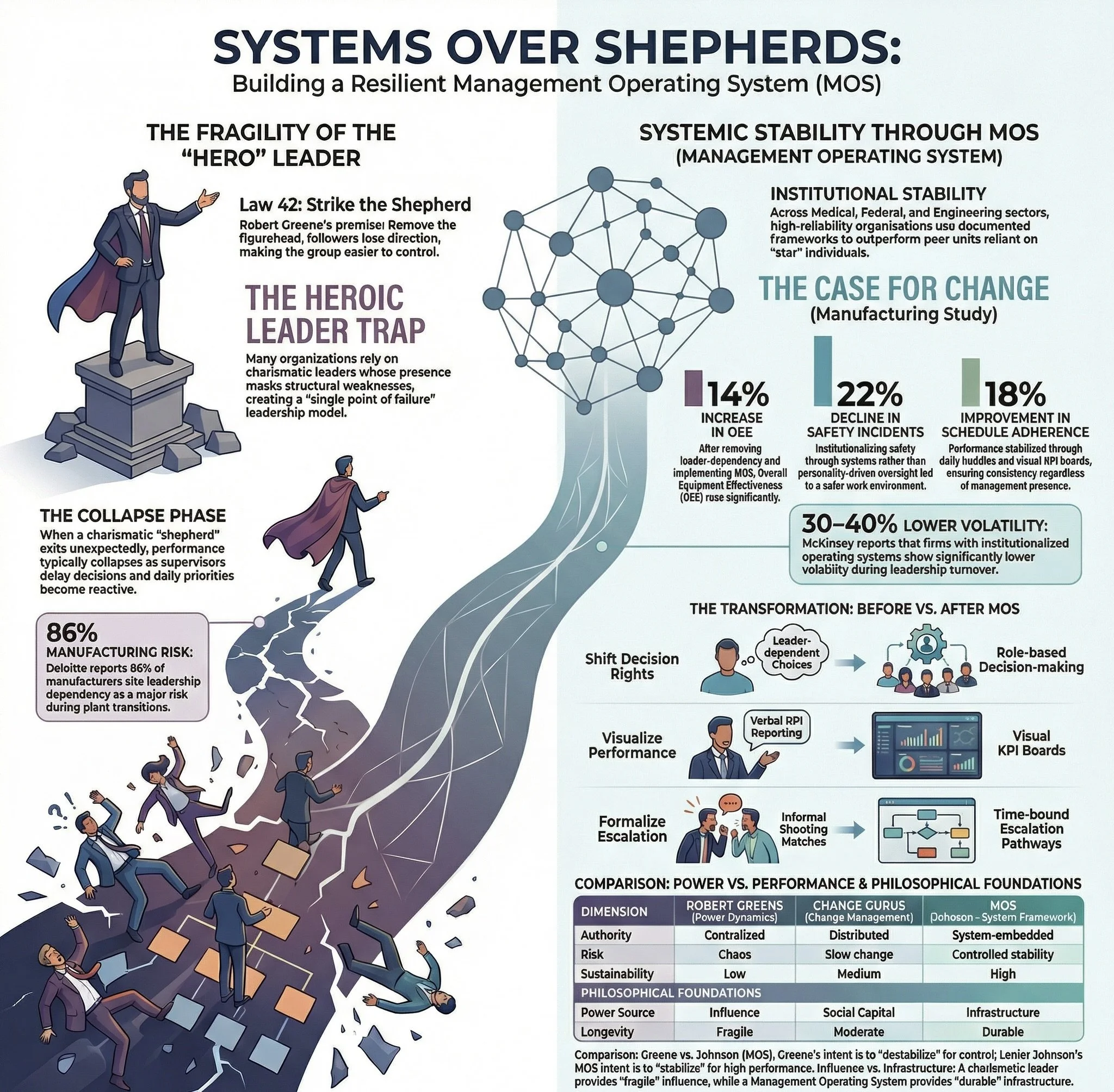
The Hidden Fragility of the "Hero" Leader
The most dangerous leaders are those whose charisma masks a total lack of infrastructure. Executives frequently fall into the trap of the "Hero Leader," mistake-proofing their own egos while leaving the organization fundamentally fragile. They mistake a cult of personality for a high-performance culture. But charisma is not a strategy; it is a structural liability.
Consider the mid-size manufacturing plant that recently served as a cautionary tale. For years, the facility thrived under a charismatic Plant Manager who acted as the sole arbiter of truth. When he unexpectedly exited, the "flock" didn't just stumble—it collapsed. Decisions stalled, priorities became purely reactive, and the absence of a "shepherd" revealed that the organization had never actually learned how to function. It was a group of followers, not a business. Ask yourself: if your organization faced a sudden "strike to the shepherd," would your teams maintain their pace, or would they scatter into chaos?
The High Cost of the "Shepherd" Dependency
Robert Greene’s 42nd Law of Power offers a ruthless but necessary truth: "Strike the shepherd and the sheep will scatter." This isn't just a tactic for destabilizing enemies; it is a diagnostic tool for organizational health.
"If you want to destabilize a group, target the leader. When you remove the figurehead, the followers lose direction and become disoriented. By eliminating the source of authority, you make it much easier to control or manipulate the rest of the group."
When authority is concentrated in a person rather than a process, you have created a single point of failure. The data bears this out. Deloitte reports that 86% of manufacturers cite leadership dependency as a primary risk during plant transitions. Conversely, McKinsey findings show that firms that institutionalize their systems experience 30–40% lower volatility during leadership turnover. If your company’s success depends on the mood or presence of a single individual, you are operating on the edge of a precipice.
Striking the Shepherd as a Strategic Opportunity
In the manufacturing case study, the executive team did something cold-blooded and brilliant: they chose Controlled Destabilization. Instead of rushing to install a new "hero" to fill the vacuum, they intentionally paused. They allowed the organization to feel the discomfort of the leadership gap to force the culture to confront its own dependency.
This pause served as a psychological reset. By refusing to provide a new shepherd, they forced the employees to stop looking upward for permission and start looking at the process for direction. This forced a transition from leader-dependent behaviors to role-based decision-making. The goal was to train the organization in navigating by shared rules instead of personality cues. The vacuum wasn't a problem to be solved; it was the catalyst for cultural maturity.
Engineering Authority via the Management Operating System (MOS)
To move from "Influence" to "Infrastructure," the organization turned to Lenier Johnson’s principles of the Management Operating System (MOS). Rather than relying on a manager's personal drive, they engineered authority directly into the system by implementing 20 discrete elements of operational discipline.
This MOS replaced individual whim with a rigorous framework of tiered huddles, visual KPI boards, and supervisor standard work. While Robert Greene’s Law 42 is designed to create chaos, Johnson’s MOS uses the removal of the shepherd to install a "Management Operating System" that stabilizes the environment. Authority was no longer a person; it was the rhythm of the business.
Philosophical Foundations: Influence vs. Infrastructure
Model
Power Source
Longevity
Charismatic Leader
Individual Influence
Fragile
Coalition/Social Group
Social Capital
Moderate
MOS (Johnson)
Infrastructure
Durable
The Quantifiable Power of Systemic Discipline
The results of replacing a shepherd with a system are not just philosophical—they are measurable. Once the "20 elements" were embedded, the organization achieved levels of performance that the previous "hero" leader never reached. By removing the single point of failure and replacing it with standard work and visual controls, the facility achieved:
• 14% increase in Overall Equipment Effectiveness (OEE).
• 22% decline in safety incidents.
• 18% improvement in schedule adherence.
These gains were sustained precisely because they did not rely on a supervisor’s charisma to "motivate" the team. Performance stabilized because the system took over the heavy lifting of accountability.
Why Traditional Change Management Gurus Are Too Slow
Traditional change management frameworks often fail because they are too soft and too slow. While Peter Senge waits for "shared learning" to take root and John Kotter spends months building "guiding coalitions," the MOS approach recognizes the immediate power realities of the shop floor.
Gurus like Rosabeth Moss Kanter focus on "empowerment networks," but the MOS focus is on engineering behavior through infrastructure. While Senge and Senge focus on social capital, the MOS installs a daily cadence and visual triggers that leave no room for ambiguity. It is a faster, more sustainable method of stabilization because it doesn't wait for people to "buy in"—it changes the environment so that performance is the only logical outcome.
Conclusion: Civilizing Law 42 through Discipline
Law 42 is an inevitable law of human dynamics. Power will eventually shift, and figureheads will eventually depart. A Management Operating System ensures that when the shepherd is struck, the sheep don't scatter—they simply keep following the system.
True cultural maturity is reached only when leadership is engineered into the organization's DNA, not inherited by the next charismatic individual in line. It is time to stop building legacies of followers and start building an infrastructure that makes your presence optional.
Is your leadership building a sustainable system, or are you just the next shepherd waiting to be struck?