
The Art of Invisible Influence: 5 Surprising Lessons from the Corporate Underworld
1. Introduction: The High Cost of Being "Too Good"
In the high-stakes environment of modern business, talent is often viewed as a universal currency. Yet, as a workplace culture strategist, I frequently observe a recurring pathology: the high-performing executive who hits a ceiling not because of a lack of skill, but due to "organizational friction." These individuals suffer from the delusion that technical brilliance alone guarantees advancement, ignoring the shadow dynamics that dictate professional survival.
Robert Greene’s The 48 Laws of Power serves as a taboo yet indispensable manual for managing this political navigation. While critics often dismiss it as sociopathic, in the hands of a behavioral analyst, it is a sophisticated framework for risk management. To master these laws, one must first redefine the "Master." In a corporate hierarchy, a Master is not merely a direct supervisor; they are any individual in a position of authority whose psychological security is the gatekeeper to your progress.
2. The Counter-Intuitive Power of Subservience (Law 1)
The most significant career risk is not incompetence, but the accidental provocation of a superior’s ego. Law 1, "Never Outshine the Master," is essentially a mandate for maintaining Psychological Safety. To secure your own upward mobility, you must ensure that those above you feel "comfortably superior."
When a subordinate displays excessive brilliance, they often inadvertently signal that they are a threat to the established order. This triggers insecurity, which manifests as micro-management, credit-stealing, or active sabotage. By making the Master appear more brilliant than they are, you neutralize their defensive instincts, transforming a potential adversary into a patron.
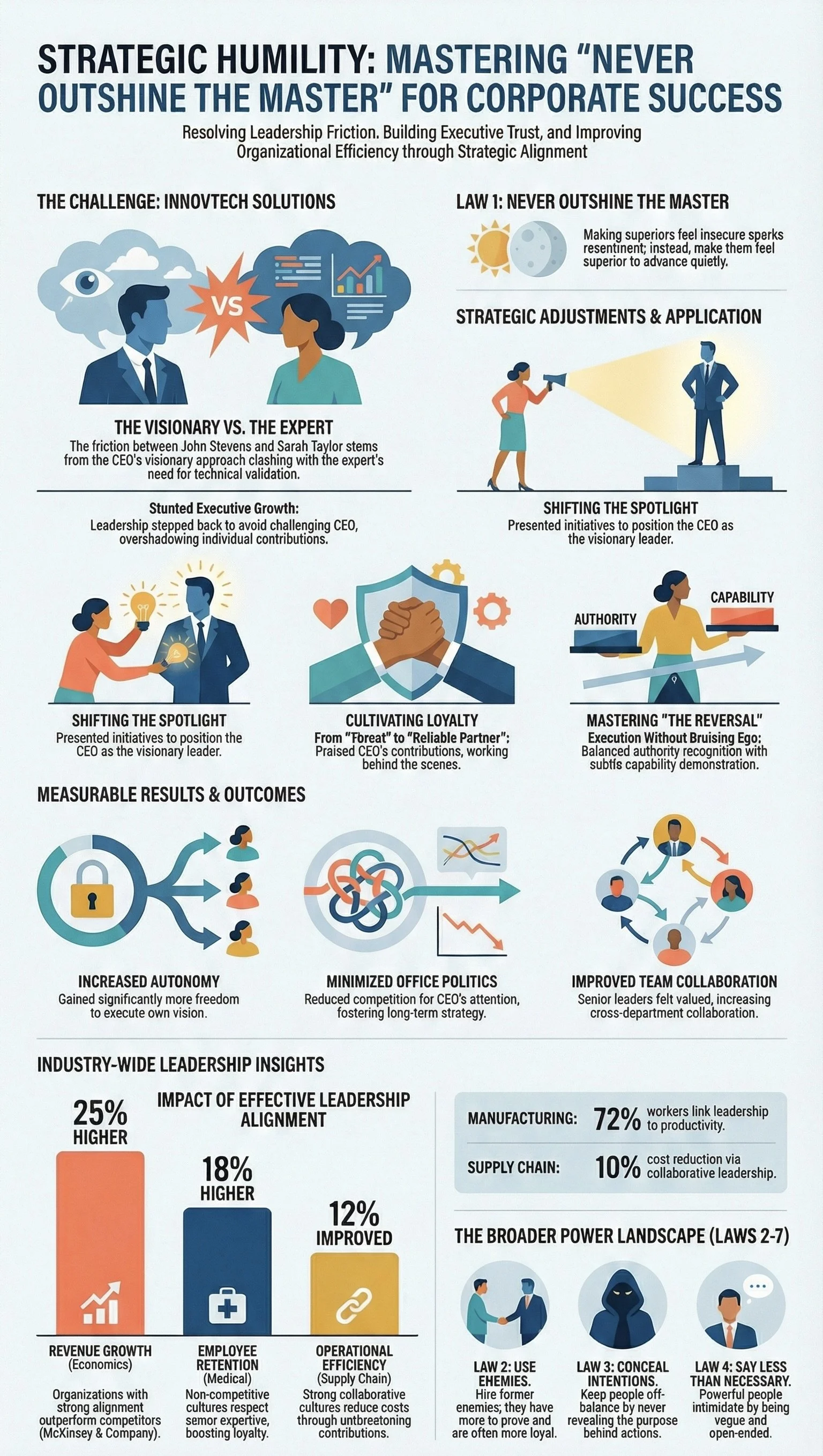
Law 1: Never Outshine the Master Always make those above you feel superior. If you make them feel insecure, you will spark resentment. Instead, allow them to take the credit for the work and stand by their accomplishments. The key is to make them feel good about themselves while you quietly advance behind the scenes. It’s about creating loyalty and avoiding any threats to their sense of power.
3. Case Study: Why the "Smartest Person in the Room" Often Loses
The strategic necessity of this law is perfectly captured in the case of InnovTech Solutions. When the firm hired Sarah Taylor, a highly skilled veteran, to lead product development, she immediately clashed with CEO John Stevens—a visionary founder known for his micromanagement. Sarah’s overt drive and technical expertise created immediate friction, as her ideas frequently stood in direct contrast to Stevens’ vision.
Recognizing that her expertise was becoming a liability, Sarah executed a radical strategic shift. She moved away from overt competition and toward a "behind-the-scenes" influence model. She began subtly presenting her initiatives in ways that positioned Stevens as the visionary leader behind the innovations. She prioritized praising Stevens’ contributionspublicly and worked to foster relationships with other executives, positioning herself as a reliable partner rather than a rival.
By ensuring Stevens felt unchallenged and secure in his authority, Sarah earned a level of trust and autonomy she could never have gained through merit alone. The result was not just personal advancement, but a total stabilization of her division’s output.
4. The Bottom Line: Why Power Alignment is Profitable
Aligning with existing power structures isn't just a survival tactic; it is a driver of organizational efficiency. When leadership is fractured by internal competition, productivity collapses. The data reflects the tangible cost of hierarchy instability:
Manufacturing: According to the Manufacturing Institute, 72% of workers believe effective leadership has a direct impact on productivity. When subordinates outshine or threaten the hierarchy, the "primary driver" of productivity—trust—is eroded, leading to systemic operational slowdowns.
Economics and Finance: A McKinsey study revealed that organizations with strong leadership alignment—where power dynamics are settled and cohesive—experience 25% higher revenue growth compared to fragmented teams.
Medical: Research published in the Journal of Healthcare Leadership found that hospitals with non-competitive, respectful leadership cultures saw an 18% higher staff retention rate. In high-stakes environments, respecting the "Master’s" expertise ensures smoother operations and better patient care.
5. Power as a Defensive Shield: The EQ of Risk
Common criticism of Greene’s work often misses its most pragmatic application: Emotional Intelligence (EQ). For the "normal person" navigating a corporate underworld, these laws are defensive shields. As noted in professional discourse and practitioners' circles, the book is an "extremely accurate description of a certain type of person"—the narcissist or the "shitty boss."
Understanding these laws allows an employee to recognize when they are being "spied on" (Law 14) or when a superior is attempting to use them as a "Cat's-paw" to do their dirty work. Furthermore, Greene’s inclusion of a "Reversal" for each law demonstrates the strategist’s need for fluidity. A true analyst knows when to ignore the law; while "transparency" is often a target for predators, there are moments where "Formlessness" (Law 48) is the only way to avoid a direct hit. Failing to recognize these patterns results in unnecessary career attrition and burnout.
6. The Mastery of Self and Reputation
Professional power is built on the twin pillars of Image Management and Reputation. Law 5 states that "Reputation is the cornerstone of power; once it slips, you are vulnerable, and will be attacked on all sides." A strategist maintains an unassailable reputation while subtly eroding the credibility of rivals.
Furthermore, Law 26 emphasizes the need to "Keep Your Hands Clean." To maintain a "spotless appearance," one must never be tied to mistakes or petty office squabbles, often utilizing others as scapegoats or cat's-paws to disguise involvement. This internal self-mastery allows an individual to employ Law 44, the Mirror Effect, which is the ultimate tool for cultural alignment.
Law 44: Disarm and Infuriate with the Mirror Effect The mirror reflects reality, but it is also the perfect tool for deception: When you mirror your enemies, doing exactly as they do, they cannot figure out your strategy. By holding up a mirror to their psyches, you seduce them with the illusion that you share their values.
7. Conclusion: Navigating the Formless Future
The final lesson of power is found in Law 48: "Assume Formlessness." In an era of rapid disruption, the most effective professionals are those who remain fluid, adaptable, and impossible to pin down. Power dynamics are a permanent feature of the human workplace; they cannot be ignored, only managed.
As you evaluate your current standing, remember that your greatest vulnerability is often your own desire for recognition. In a landscape where your boss's insecurity is your greatest career risk, is your "radical transparency" a badge of honor, or is it the bullseye on your back?