
As leaders, we are often driven by the desire to create calm, stable, and harmonious work environments. We equate a lack of turbulence with a healthy culture, believing that a smooth-running ship is a successful one. But this pursuit of stability, while well-intentioned, can mask deep-seated problems and prevent a team from reaching its true potential.
What if the relentless pursuit of calm is actually a sign of stagnation? This question forces us to consider a counter-intuitive but powerful leadership tool: controlled disruption. By deliberately "stirring up the waters," we can expose uncomfortable truths, challenge hidden assumptions, and spark the kind of authentic growth that artificial harmony can never produce.
Stability Can Be a Trap
An environment that appears calm on the surface can hide profound organizational decay. This "artificial harmony" is often the quiet abdication of leadership responsibility, serving as a cover for risk avoidance, unresolved conflicts, and slowly eroding performance. What looks like alignment may simply be a collective agreement to avoid difficult conversations.
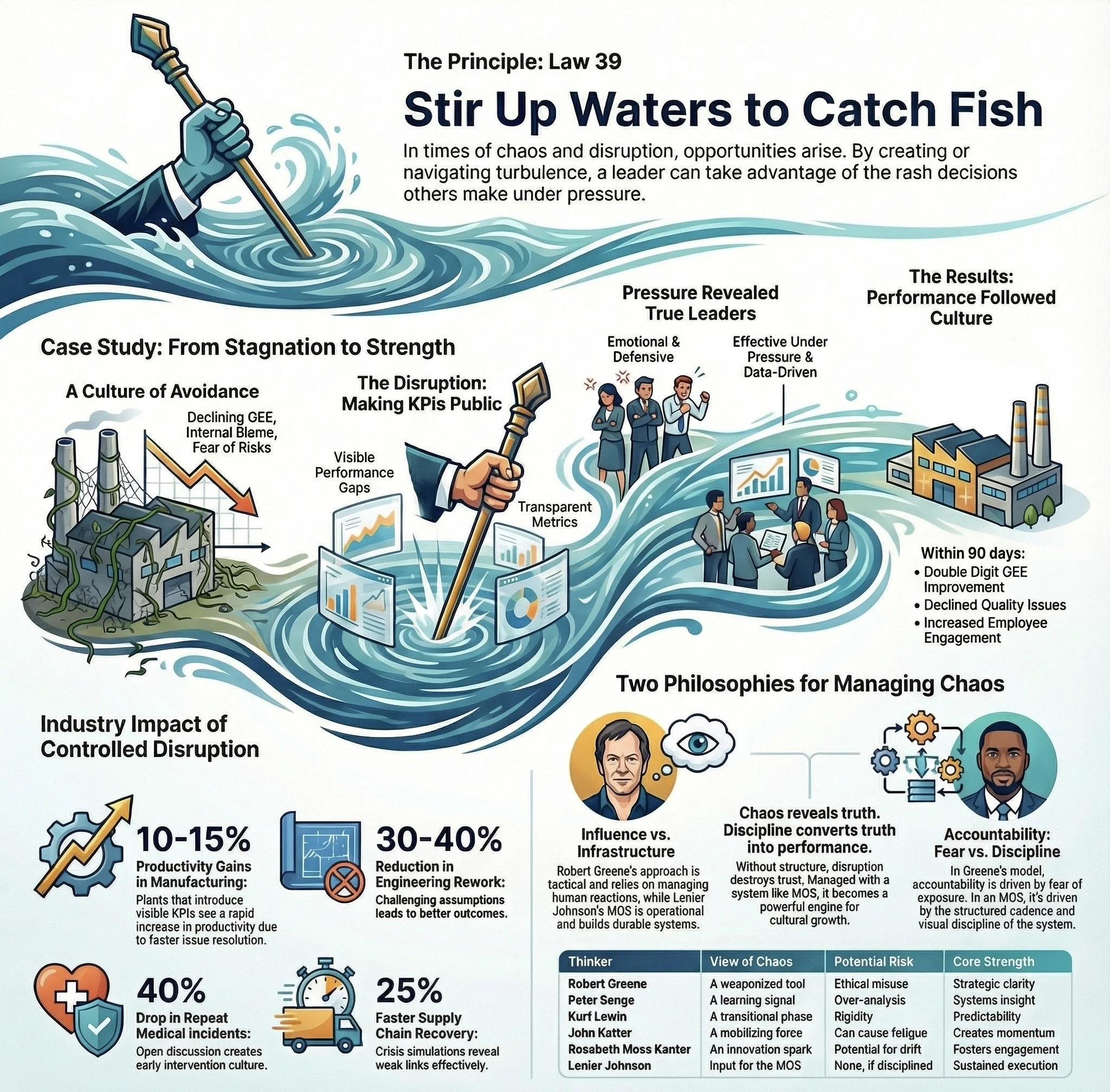
Consider the case of a mid-size manufacturing company that projected calm stability, but its performance data revealed a story of stagnation, including declining OEE (Overall Equipment Effectiveness). A closer look uncovered a culture suffering from chronic finger-pointing and risk avoidance, where problems were managed through private negotiations rather than transparent solutions. The apparent peace was not a sign of health but of systemic avoidance. This shows that leaders must be wary of such tranquility and ask whether their team’s calm is a reflection of productive efficiency or a symptom of a culture that fears the truth.
Transparency Is the Ultimate Disruptor
Strategic disruption does not require manufacturing personal conflict or creating anarchy. One of the most effective and disciplined forms of disruption is the introduction of radical transparency. By making objective truths visible, leaders can force a necessary confrontation with reality without making it personal.
In the manufacturing company, leadership’s primary action was to publicly display tier-level KPIs for the first time. This single act immediately stirred the waters, triggering tension as managers realized performance gaps were visible to peers. Missed targets, once handled in private, were now undeniable and subject to collective scrutiny. The disruption forced a fundamental shift from a culture of negotiated privacy to one of radical integrity, making the status quo impossible to maintain. This proves that objective truth, when revealed, is the most powerful catalyst for change.
Managed Conflict Builds Psychological Safety
It is a profound paradox of leadership that allowing controlled conflict to surface can dramatically improve trust and psychological safety. When leaders create an environment where difficult truths can be spoken without fear of punishment, they build a more resilient and honest culture.
When the manufacturing company’s performance data was made public, some leaders reacted emotionally with defensiveness and blame. Instead of shutting down these reactions, the executive team allowed them to play out under observation. This served a dual purpose: it not only allowed for catharsis but also revealed who could lead under pressure and who relied on opacity for protection. The surprising result was that psychological safety improved; employees learned that surfacing problems did not result in punishment—but silence did. This demonstrates that true psychological safety isn't the absence of conflict; it is the institutionalization of trust.
Chaos Reveals Truth, but Discipline Creates Value
Disruption for its own sake is dangerous and can quickly erode trust. The true value of stirring the waters is only unlocked when the resulting energy is channeled through a structured system that converts chaos into constructive action. The goal is not merely to reveal truth, but to build a durable system for acting on it.
This is where two philosophies diverge. Robert Greene’s "Stir Up Waters to Catch Fish" focuses on the tactical use of chaos, an approach that is highly leader-dependent. In contrast, Lenier Johnson's philosophy centers on implementing a Management Operating System (MOS) to channel chaos into disciplined execution. Johnson's institution-embedded system is designed for turning emotion into data, creating a sustainable process for improvement that outlasts any single leader.
Without structure, disruption destroys trust. With MOS, disruption becomes the engine of cultural maturity.
From Chaos to Clarity
Strategic disruption is not about creating anarchy; it is about having the courage to reveal the truth and the discipline to act on it constructively. Leaders who master this skill understand that stability is not the goal—progress is. They learn to introduce turbulence with purpose, knowing that when managed through a disciplined system, it is the fastest path to building accountability, trust, and superior performance.
What uncomfortable truth does your team need to face in order to achieve its next level of growth?